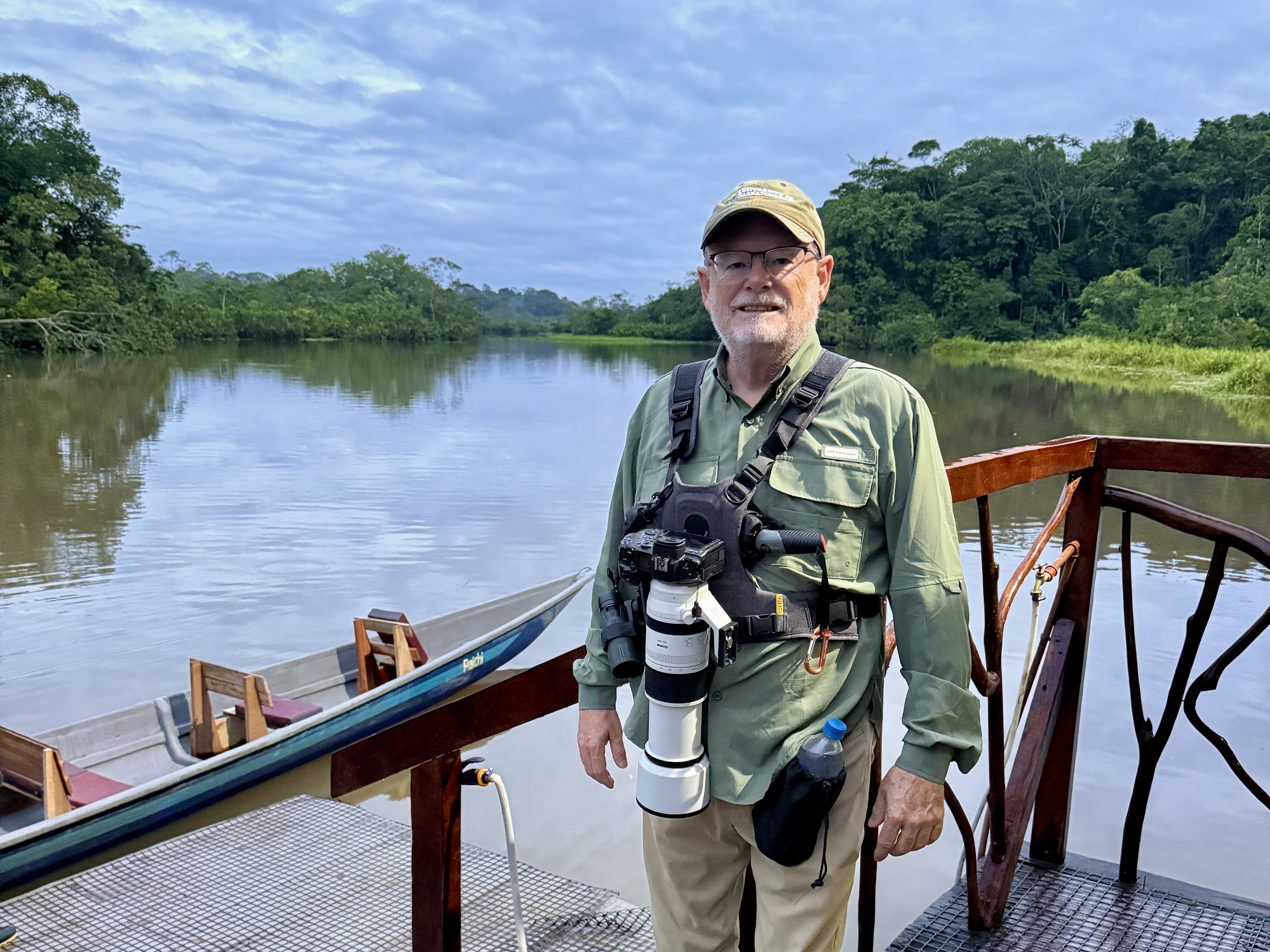
Synopsis: This epilogue looks beyond the individual bird highlights to the deeper meaning of the journey, capturing the wonder, gratitude, and renewed perspective that Ecuador left within me.

Ecuador Birding – Where Every Feather Tells a Story
From October 26, 2025 through November 8, 2025 I joined 5 other adventurers and an outstanding photographer and birding guide (Liron Gertsman) with Eagle-Eye Tours to Ecuador. This blog series highlights the animals (mostly birds), people and locations we encountered over the 14 full days in this beautiful land.
A Reflections of the Natural World Blog Post Series by Jim Gain
**Due to the high resolution and quality of the images in this blog series it is highly recommended
that readers view posts in Landscape Mode on a desktop PC from the actual blogsite at Ecuador Birding**
There are trips that entertain, trips that educate, and trips that refresh the spirit — and then there are the rare journeys that rearrange something inside you. Ecuador was that kind of journey. From the moment our group stepped into the cool, mist‑laden air of the Andes, it felt as though the country opened a door into a world where color, sound, and life were amplified. Every day brought a new elevation, a new habitat, a new cast of birds, and a new reminder that the world is far richer than we often allow ourselves to notice. Looking back now, the entire trip feels like a tapestry woven from moments of awe, challenge, laughter, and discovery.
The birds were spectacular beyond measure…

What made this adventure extraordinary wasn’t just the birds — though the birds were spectacular beyond measure — but the people who shaped the experience. The guides, lodge owners, and local families who welcomed us into their forests carried a deep, generational connection to the land. Their knowledge wasn’t just technical; it was emotional, rooted in years of watching the seasons shift and the species return. Whether it was the quiet pride of a lodge owner showing us a newly restored patch of cloudforest, or the gleam in a guide’s eye when a rare bird called from the shadows, every interaction reminded us that conservation is a human story as much as a biological one.
From there, the journey unfolded through a series of landscapes that felt like characters in their own right.

The places themselves felt like characters in the narrative. Puembo Birding Garden, with its gentle introduction to Andean species, eased us into the rhythm of Ecuadorian birding. Zuro Loma, reclaimed from pastureland and reborn through dedication and patience, embodied the power of restoration — a place where antpittas stepped out of the mossy understory like old friends.
Into the Amazon Lowlands at Saní Birding Lodge

From there, the journey widened. We left the cool breath of the Andes and descended into the vast green world of the Amazon Basin, where the air grew warmer, thicker, and alive with sound. At Sani Lodge, the Kichwa community welcomed us into their home along the Napo River with a generosity that felt both ancient and immediate. Their connection to the forest ran deeper than any field guide could capture — every plant, every call, every shift in the wind carried meaning.
Days at Sani unfolded in layers. The canopy tower, rising above the endless sea of treetops, offered a view that felt like standing on the roof of the world. From that height, macaws carved bright arcs across the sky, and mixed flocks moved through the crowns like drifting constellations. The oxbow lake, still and reflective in the early morning light, revealed Hoatzins perched like prehistoric ornaments along the water’s edge. And when night fell, the forest transformed again — the night walks revealing eyeshine in the understory, the soft wingbeats of owls, and the quiet pulse of a world that never truly sleeps.
Sani Lodge wasn’t just a destination; it was an immersion — a reminder that the Amazon is not a place you visit, but a presence you enter.
With the Amazon’s vastness still echoing in our minds, we returned to the mountains, where the eastern Andes offered a completely different rhythm of life.

Returning to the Andes, we climbed back into cooler air and entered the realm of the eastern slope, where the forests felt older, wetter, and steeped in mystery. At Cabañas San Isidro, the mornings began with mist drifting through towering trees, each branch draped in moss and orchids. Birds here seemed carved from shadow and fog — Inca Jays flashing electric blue, woodcreepers spiraling up trunks, and the enigmatic “San Isidro Owl” haunting the dusk.
Further upslope at Guango Lodge, the world tightened into a lush, intimate corridor of rushing rivers and dense understory. Hummingbirds ruled this domain — swordtails, chestnut-breasts, tourmalines — each one a burst of color against the green. The trails wound through dripping foliage, every turn revealing another species sculpted by the cool, wet climate of the eastern cloudforest.
Onward and UPWARD to the Papallacta Radio Towers!

And then, higher still, the landscape opened into the stark, windswept páramo around Papallacta, where the air thinned and the cold settled into our bones. At the top of the pass near the radio towers, at over 14,000′, the world vanished into a dense, shifting fog — visibility shrinking to barely a few dozen feet as clouds swept across the ridge in heavy, breath‑like pulses. The wind carried a sharp, metallic edge, tugging at jackets and hoods, and every sound felt muted, swallowed by the mist. Grasses bent low under the constant push of the breeze, their forms dissolving and reappearing as the fog drifted past. It was a place stripped to its essentials, where even the horizon felt uncertain, hidden behind curtains of white. The páramo held a kind of ancient gravity in that weather — raw, austere, and unforgettable, a landscape that revealed its power not through vistas, but through presence.
Across to the Land of the Condor – Tambo Cóndor

Not far beyond the pass, the land dropped away into the dramatic cliffs and deep canyons surrounding Tambo Condor, a place where the Andes seemed to fold and refold into themselves in sweeping, impossible layers. The lodge perched on a natural balcony above the valley, offering views so vast they felt like stepping into open sky. Here, Andean Condors rode the thermals with effortless grace, their shadows gliding across the canyon walls as if stitched to the wind itself. The cliffs glowed gold in the afternoon light, and the air carried the scent of sun‑warmed earth and high‑country shrubs. And in one of those moments that felt like a gift from the landscape, a local rancher passed along the ridge with his two grown sons, all three on horseback, dressed in traditional high‑Andean hats and ponchos. They moved with the ease of people who belong to the land, their silhouettes framed against the vastness of the canyon — a quiet reminder that this place is not just habitat, but home. Tambo Condor held a grandeur that was both human and wild, a meeting point of culture, landscape, and sky.


As we left the stark beauty of the high Andes behind, the landscape eased into the lush, rain‑washed forests of the western slope.
Only after all of that did we descend into the western cloudforest, where the world softened into greens and golds and the air carried the scent of rain and orchids. The mid‑elevation forests here felt intimate and alive, a place where every bend in the road revealed another curtain of moss‑draped trees or a sudden burst of birdsong.


At Refugio Paz de las Aves, the forest seemed to breathe around us, its understory alive with movement and possibility. The Guaycapi area opened into sweeping views and quiet valleys where tanagers, toucans, and hummingbirds stitched color through the canopy. Tandayapa wrapped us in its familiar rhythm of feeders, forest edges, and the constant shimmer of wings, a place where time felt suspended. And along the trails of Sendero Frutti Tour, the cloudforest revealed its quieter magic — fruiting trees, hidden perches, and the sense that something extraordinary might appear at any moment. Together, these places formed the gentle, beating heart of the western slope, each offering its own mood, its own palette, its own voice.
And then there were the hummingbirds of Zuro Loma — the true reason of the journey.

The antpittas that emerged from the shadows with improbable trust. The mountain‑tanagers that lit up the canopy with impossible reds, blues, and yellows. The hummingbirds that defied physics, shimmering in colors that seemed invented rather than evolved. The toucans, bold and sculptural, whose calls echoed through the valleys like ancient instruments. And of course, the Sword‑billed Hummingbird — the bird that had lived in my imagination for years, finally captured in a series of photographs that felt like a dream made real. Each species was a story, a moment, a memory that stitched itself into the fabric of the trip.
And the critically endangered Black‑breasted Puffleg

And then there was the moment that felt like a gift from the universe itself — our encounter with the critically endangered Black‑breasted Puffleg. To witness a species with fewer than a hundred individuals left on Earth was something beyond luck; it felt like stepping into a story still being written. This tiny hummingbird, dark as obsidian with a flash of iridescent fire in its throat, carries the weight of an entire ecosystem on its wings. Its survival depends on the fragile remnants of high‑elevation forest clinging to the slopes of Pichincha, protected only through the fierce dedication of local conservationists. Seeing it alive, feeding, hovering, simply being — it was a moment that stitched humility and hope together in a way I will never forget.
The rhythm of discovery

But the journey wasn’t just about checking species off a list. It was about the rhythm of discovery — the early mornings, the long hikes, the quiet moments waiting for a bird to appear, the shared excitement when it finally did. It was about the camaraderie within our group of six bird photographers, each of us bringing our own instincts, humor, and way of seeing. Our guide, Liron Gertsman, carried an infectious enthusiasm and a gift for spotting the impossible; our driver, José Gallardo, navigated every road and trail with calm expertise and a deep knowledge of the land. Together, the whole entourage created an atmosphere where every sighting felt communal, every challenge shared, every triumph multiplied. Traveling with people who care about the same things transforms the experience; it becomes a collaboration, a collective archive of stories and images that will be retold for years.
Challenges overcome

There were challenges, too — the steep trails, the thin air, the unpredictable weather, the birds that refused to cooperate, the bouts of sickness that shadowed parts of the journey, and the gut‑punch of losing an entire SD card with more than two thousand images. Some days required pushing through fatigue or discomfort; others demanded accepting a loss that couldn’t be undone, no matter how carefully the rest of the trip was documented. Yet each difficulty only sharpened the sense of accomplishment. Every lifer felt earned. Every photograph felt like a small victory. And every setback — whether physical, emotional, or digital — made the successes sweeter. Ecuador taught me patience, humility, and the quiet strength of embracing the unexpected.
What lingers most now, in the quiet after the journey, is gratitude. Gratitude for the people who protect these forests. Gratitude for the birds that still thrive in them. Gratitude for the chance to witness such beauty firsthand. And gratitude for the reminder that the world is still full of wonder — that even in a time when so much feels uncertain, there are places where life continues to flourish in dazzling, improbable ways.
Never to be Forgotten

As I look back on the photographs, the notes, and the memories, I realize that this trip wasn’t just a birding adventure. It was a reconnection — with nature, with curiosity, with the part of myself that still feels awe like a child seeing something for the first time. Ecuador didn’t just give me lifers; it gave me perspective. It reminded me why I pick up a camera, why I travel, why I seek out wild places. It reminded me that beauty is worth chasing, worth protecting, worth celebrating.
Previous Ecuador Birding Blog Posts:
- The Velvet‑purple Coronet and the Science of Color: A Field Photographer’s Reflection
 A quiet Gray Fox along the Stanislaus River offered a moment of Zen‑like stillness, blending natural history, resilience, and the calm grace of wildness moving at its own pace.
 - EB100 – Epilogue – Full of Wonder and Gratitude
 This epilogue looks beyond the individual bird highlights to the deeper meaning of the journey, capturing the wonder, gratitude, and renewed perspective that Ecuador left within me. This blog series chronicles Jim Gain’s experiences with birds and nature.
 - EB99 – Ecuador – Favorite Images from the West Andes
 This epilogue looks beyond the individual bird highlights to the deeper meaning of the journey, capturing the wonder, gratitude, and renewed perspective that Ecuador left within me. This blog series chronicles Jim Gain’s experiences with birds and nature.

Through my lens and prose I hope to instill a greater sense of awe, compassion and inspiration as I discover new creatures, explore interesting habitats, and gain wisdom about the natural world that’s all around us. It is my hope that readers are motivated to learn more about our environment and its inhabitants, and become passionate advocates for conservation.
>>Ecuador Birding Blog Home Page Link https://reflectionsofthenaturalworld.com/ecuador-birding/

*This Ecuador Birding blog post was shaped and polished with the assistance of Microsoft Copilot, helping bring clarity and a consistent flow to my field notes and dictated memories.
**Unless otherwise indicated in the image caption, all photographs (>99.9%) are mine.

Leave a Reply