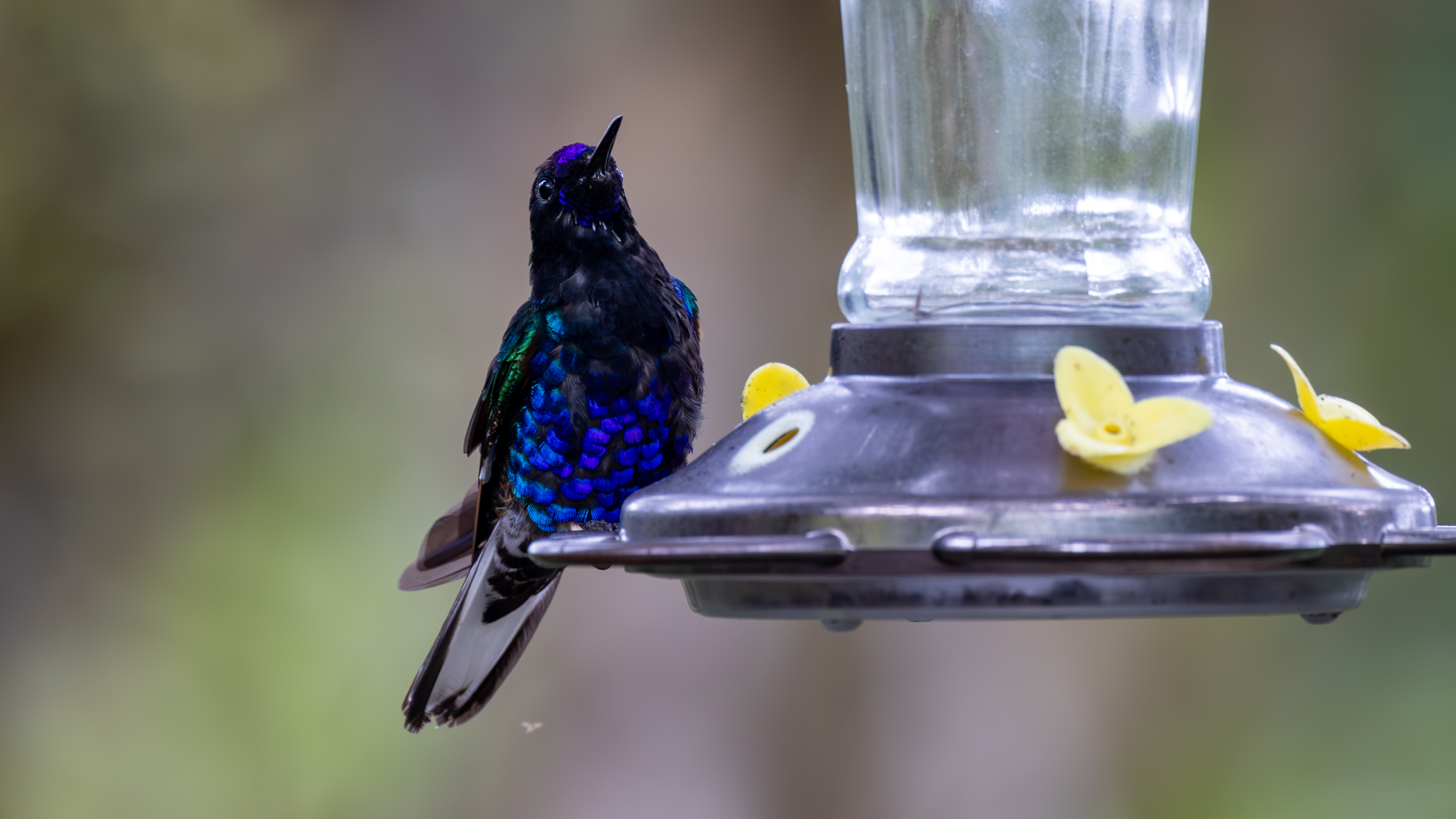
Synopsis: The post explores how the Velvet‑purple Coronet earns its title as the world’s most colorful bird through cutting‑edge color‑space research, weaving that science together with field experience and reflections on the brilliance of other vividly plumaged species.

There are moments in the field — a feather caught in morning light, a bird’s call echoing across a quiet valley, the slow drift of clouds over a familiar horizon — when the world feels both exquisitely simple and impossibly vast. The Lightness of Being is born from those moments. This series explores the gentle intersection of nature, science, and the human search for meaning, inviting readers into a space where observation becomes reflection and the wild world becomes a lens for understanding our own inner landscapes.
A Bird That Redefines “Colorful”
The Velvet‑purple Coronet (Boissonneaua jardini) is one of those birds that seems almost impossible when you first see it—an eruption of violet, indigo, emerald, and copper that shifts with every angle of light. I remember photographing this species in Ecuador and feeling as though the bird was actively rewriting the rules of color each time it moved.

Science now backs up that intuition.
A 2022 study in Communications Biology measured plumage coloration across 114 hummingbird species, collecting more than 1,600 spectrophotometric readings. Instead of relying on human perception, the researchers translated those measurements into a model of avian visual-sensitive (VS) color space—a representation of how birds themselves see color, which includes ultraviolet wavelengths invisible to us.
And the species with the largest measured color gamut was:
Velvet‑purple Coronet — 13.8% of the entire avian VS color space.
In other words, this single hummingbird occupies more of the bird-visible color universe than any other species measured. It is not just colorful to us—it is objectively colorful to birds.
Why Hummingbirds Are Masters of Light

Hummingbirds are uniquely equipped for color brilliance. Their feathers contain nanostructures—microscopic layers of keratin and air pockets—that manipulate light through interference. Instead of pigment alone, their colors arise from structural iridescence, meaning:
- Color shifts with angle
- Brightness intensifies in direct light
- UV reflectance adds hues humans cannot see

The Velvet‑purple Coronet’s plumage is a masterclass in this physics. Its feathers behave like tiny prisms, scattering and amplifying wavelengths in ways that make the bird appear to glow from within.
Field Notes: When Science Meets Experience
Photographing this species in Ecuador, I felt the same astonishment the data later confirmed. The coronet doesn’t simply flash color—it performs it. Every wingbeat is a shift in the spectrum. Every hover is a new palette. Even perched, it seems to radiate a kind of chromatic confidence.
But the science adds something deeper: It reminds us that our human eyes only catch a fraction of what birds see. The coronet’s true brilliance exists partly outside our perception, in wavelengths we can’t witness but can imagine.

How the Four Motifs Shape My Experience of Color
Moments with birds like the Velvet‑purple Coronet gather all four of my nature‑watching motifs into a single, layered experience. Zen is the first to rise—the quiet astonishment of seeing a creature so saturated with light that it feels almost unreal. Science follows, giving structure to that wonder: the spectrophotometric measurements, the avian color‑space models, the realization that this bird occupies more of the visible universe than almost any other species. Through Art, I try to translate that shifting iridescence into a photograph, knowing the camera can only approximate what the bird truly is. And then comes Education, the motif that ties everything together—each encounter teaching me something new about how color works, how birds perceive the world, and how much remains invisible to us. In the coronet, these four motifs don’t sit side by side; they braid into one moment, reminding me why I return to the field again and again.

Reflections on Other Masters of Color
The coronet may top the measured list, but it belongs to a larger lineage of birds that push the boundaries of color in their own ways.
Violet‑tailed Sylph — The Ribbon of Light
A long, iridescent tail that seems to carry its own atmosphere.

Andean Cock‑of‑the‑Rock — The Color of Sunrise Made Solid
A shock of orange so intense it feels sculpted rather than feathered.

Blue‑gray Tanager — The Soft Side of Color
Proof that subtlety can be just as captivating as iridescence.

Turquoise Jay — A Cloudforest Jewel
A bird that seems painted with the saturated blues of high‑elevation mist.

Each of these species expresses color differently—through pigment, structure, or a combination of both. Together, they form a spectrum of strategies for being seen, recognized, or simply dazzling.
Color as a Way of Being
What the Velvet‑purple Coronet teaches us is that color is not decoration. It is biology, communication, physics, and sometimes—when you’re lucky enough to witness it—pure emotional impact.
Color is a way birds inhabit the world. And for those of us who photograph them, it becomes a way we remember it.


Through my lens and prose I hope to instill a greater sense of awe, compassion and inspiration as I discover new creatures, explore interesting habitats, and gain wisdom about the natural world that’s all around us. It is my hope that readers are motivated to learn more about our environment and its inhabitants, and become passionate advocates for conservation.

Curious how real encounters in the field evolve into the stories shared here? I describe my process, from observation to narration to mindful, selective AI editing, in Reflections on the Evolution of My Nature Writing Process.
Leave a Reply