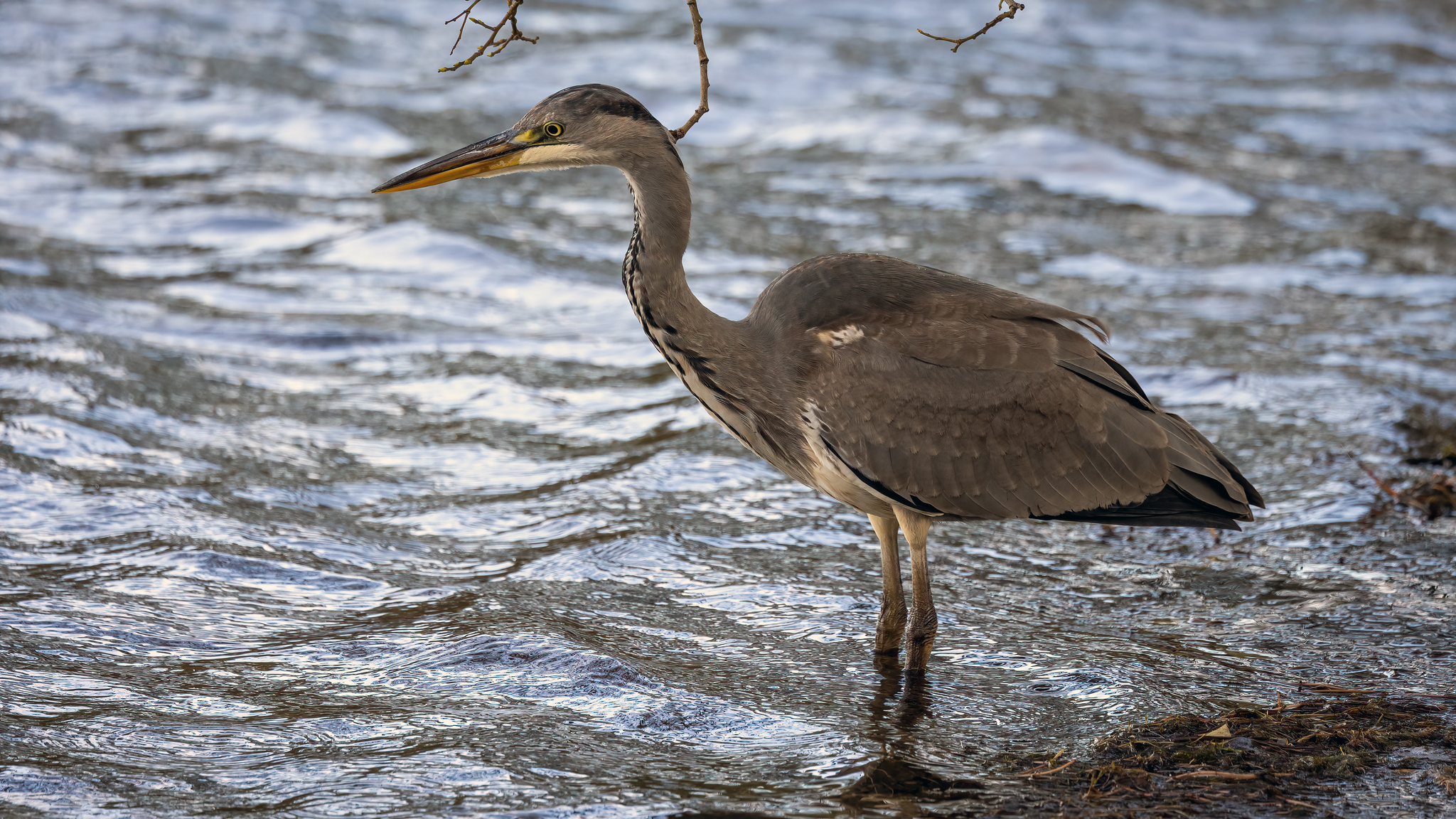

Western Europe Birds & Birding (#25/52): From the Highland Willow Scrub of Scotland to the Aegean Islands in the Sea of Crete, Western Europe is home to over 800 resident, migratory and vagrant birds. From songbirds to gamebirds and from waterfowl to raptors, you can find birds virtually in every nook and cranny of this beautiful area. *All images showcased in this blog series were taken and edited by me.
A Reflections of the Natural World Blog Post Series by Jim Gain
The Gray Heron (Ardea cinerea) is a magnificent, long-legged wading bird native to Europe, Asia, and parts of Africa.

Physical Characteristics:
The plumage of the Gray Heron is predominantly ashy-grey above, with greyish-white tones below. Notably, it sports black streaks on the flanks.
- Adult Gray Herons exhibit a white head and neck adorned with a broad black supercilium that gracefully culminates in a slender, dangling crest.
- The scapular feathers are elongated, and the feathers at the base of the neck also share this elongation.
- Immature birds lack the dark stripe on the head and appear duller overall, with a grey head and neck and a small, dark grey crest.
- Their long, straight, and powerful beaks are pinkish-yellow, particularly vibrant during breeding season.
- Yellow irises and remarkably long brown legs complete their elegant appearance.
Diet:
Gray Herons are discerning diners, primarily feasting on aquatic creatures. Their menu includes:
- Fish and eels (typically 10-25 cm long)
- Amphibians
- Crabs
- Mollusks
- Crustaceans
- Aquatic insects

Abundance and Distribution:
- These herons have a wide distribution, gracing most parts of Europe, Asia, and Africa.
- While many populations are resident, those from northern Europe migrate southward. Some remain in Central and Southern Europe, while others venture to Africa south of the Sahara Desert.
- Gray Herons thrive in various watery habitats, including:
- Lowlands
- Mountain tarns
- Lakes
- Reservoirs
- Rivers (large and small)
- Marshes

IUCN Red List Status:
The Gray Heron’s conservation status is as follows:
The Gray Heron boasts a very large population, with an estimated 790,000 to 3,700,000 adults worldwide. In Europe, there are approximately 223,000 to 391,000 breeding pairs. Its status on the IUCN Red List is Least Concern (LC), indicating that it currently faces no significant risk of extinction. These majestic birds play a crucial role in controlling fish populations and provide shelter for insects and rodents through their nests.
- Population Size: Approximately 1.4 to 2.1 million individuals.
- Life Span: Up to 23 years.
- IUCN Red List: The Great Cormorant is currently listed as Least Concern on the IUCN Red List.
For more information, you can explore the IUCN Red List and learn about the conservation status of various species.

GRAY HERON WAS LIFER #785

Leave a Reply