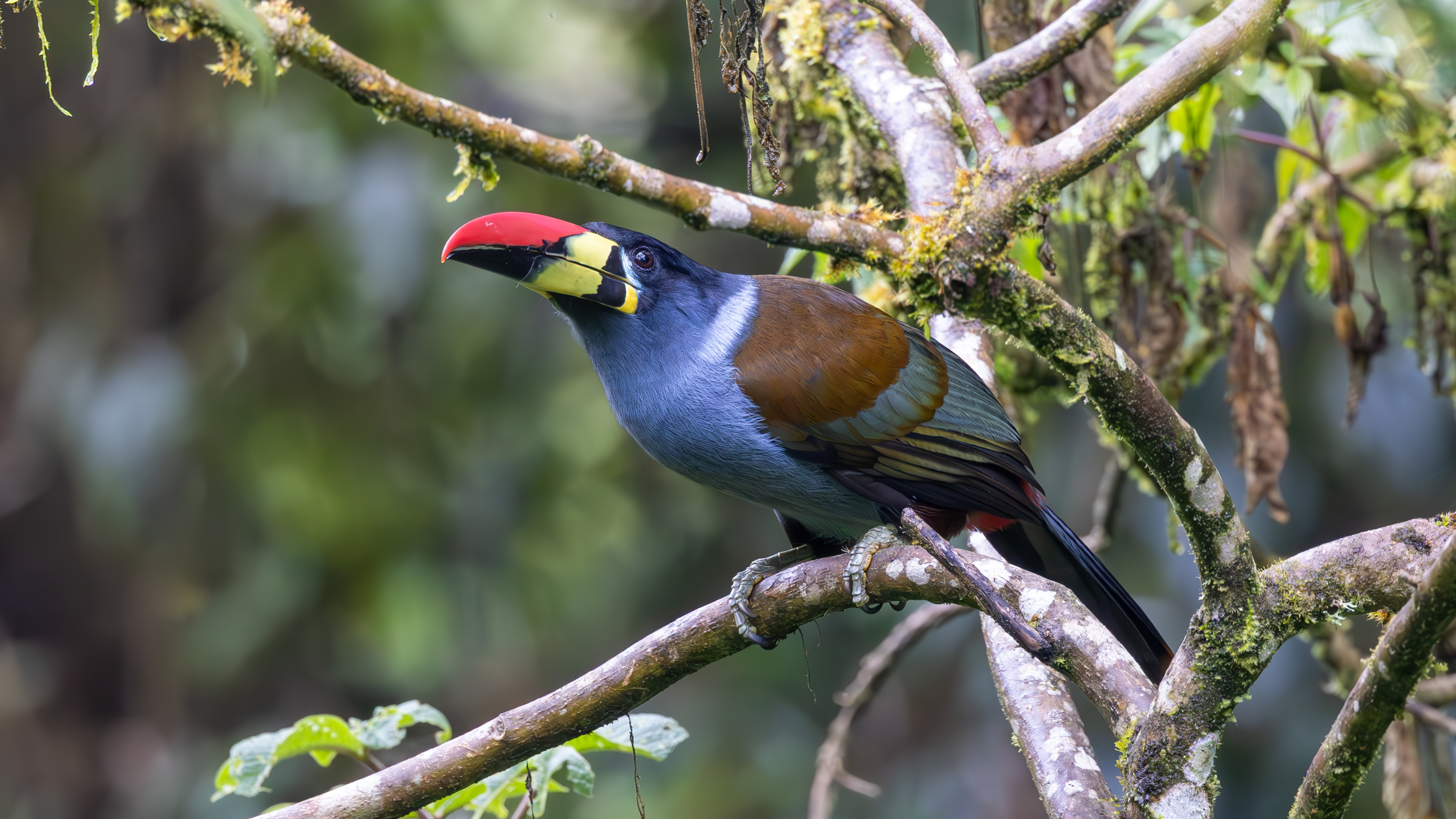
Synopsis: A steep climb above Guango Lodge led to an unforgettable encounter with Gray‑breasted Mountain‑Toucans and Pale‑naped Brushfinches—an intimate, mist‑soaked moment of color and calm that lingered with us as we descended back toward the lodge’s lively feeders.

Ecuador Birding – Where Every Feather Tells a Story
From October 26, 2025 through November 8, 2025 I joined 5 other adventurers and an outstanding photographer and birding guide (Liron Gertsman) with Eagle-Eye Tours to Ecuador. This blog series highlights the animals (mostly birds), people and locations we encountered over the 14 full days in this beautiful land.
A Reflections of the Natural World Blog Post Series by Jim Gain
**Due to the high resolution and quality of the images in this blog series it is highly recommended
that readers view posts in Landscape Mode on a desktop PC from the actual blogsite at Ecuador Birding**
DAY 9 – Mid-Morning

After photographing the Turquoise Jays, we continued up the hillside, following the narrow trail that climbed into the older, quieter forest above Guango Lodge. The air thinned and cooled as we gained elevation, and soon we reached the small feeding station tucked into the slope—a simple setup with grapes wired to a tall branch, placed with the hope of luring in one of the lodge’s most sought‑after specialties: the Gray‑breasted Mountain‑Toucan.

We settled in to wait, listening as the forest quieted around us. Before long, the first distant calls began to rise—those deep, resonant, flute‑like notes drifting down the mountainside. They grew steadily louder, closer, until the canopy above us stirred. Three Gray‑breasted Mountain‑Toucans swept across the opening in a smooth, powerful glide, their silhouettes briefly flashing against the pale sky. Instead of dropping straight in, they circled wide and looped back, slipping into the foliage just above and to the side of the fruiting tree. For a moment they vanished into the tangle of moss and leaves. Then, one by one, they began to descend—cautious, deliberate—hopping from branch to branch, pausing often to assess the scene below. Gradually, almost ceremonially, they worked their way downward until at last each bird stepped onto the broad, horizontal limb where the clusters of grapes waited.
As the toucans settled in to feed, the story of this place came into sharper focus.

Over the years, places like this have quietly transformed, shaped in part by the rise of thoughtful ecotourism. What began as simple fruiting trees near a lodge has evolved into a carefully tended micro‑habitat—one that supports both wildlife and the people who steward these forests. Some visitors question whether providing fruit or maintaining feeding sites alters natural behavior, but in practice, these setups often function as supplemental resources rather than replacements for wild foraging. In regions where habitat loss and fragmentation continue to pressure native species, a well‑managed feeding station can act as a small but meaningful refuge.
Watching them feed here reveals how these carefully tended sites can quietly support the birds themselves.

For toucans in particular—wide‑ranging frugivores that disperse seeds across vast stretches of forest—these sites offer safe, predictable stopovers that help sustain local populations while still allowing them to perform their ecological role. And because ecotourism directly funds habitat protection, trail maintenance, and forest restoration, the birds ultimately benefit from a landscape that remains intact and valued rather than cleared or converted.
And it wasn’t just the toucans drawn to the feast.

Before long, another visitor slipped into view—the Pale‑naped Brushfinch, a species as bold in personality as it is striking in pattern. Its crisp black hood, pale nape, and warm yellow underparts flashed brightly each time it darted between the shadows, giving the bird a sharp, almost tailored look against the mossy backdrop. Brushfinches are quick, purposeful feeders, hopping with a kind of confident urgency as they inspect each cluster of fruit. At the station, this individual moved with practiced ease, snatching berries and retreating to a nearby perch to swallow them whole.

Like the toucans, it benefits from the stability these sites provide: a predictable, low‑risk foraging stop that supplements its natural diet without replacing the need to forage widely in the surrounding forest. In landscapes where undergrowth is increasingly fragmented, these small pockets of abundance help sustain species that rely on dense, fruit‑rich understory habitats—another quiet reminder of how thoughtful ecotourism can support the very wildlife that draws people here in the first place.

It was the kind of encounter that defines a trip: intimate, unexpected, and unforgettable. The Gray‑breasted Mountain‑Toucan is such a remarkable bird—both visually and behaviorally—that it deserves its own dedicated post, a space to explore the magic of seeing it so close and so well. When the toucans finally melted back into the forest and the brushfinches retreated to the understory, we made our way down the hillside, returning to the lodge grounds and the familiar hum of the feeders below, still carrying the thrill of that extraordinary visit.

The walk back down from the toucan feeding station felt lighter, as if the forest itself had exhaled after that extraordinary encounter. By the time we reached the lodge grounds again, the familiar hum of activity around the feeders had picked up, offering one more burst of color before the morning gave way to afternoon.
NEXT UP: EB#51 “Back to the Feeders: New Colors in the Gardens of Guango Lodge“
Additional Photographs and Video


Previous Ecuador Birding Blog Posts:
- EB100 – Epilogue – Full of Wonder and Gratitude
 This epilogue looks beyond the individual bird highlights to the deeper meaning of the journey, capturing the wonder, gratitude, and renewed perspective that Ecuador left within me. This blog series chronicles Jim Gain’s experiences with birds and nature.
 - EB99 – Ecuador – Favorite Images from the West Andes
 This epilogue looks beyond the individual bird highlights to the deeper meaning of the journey, capturing the wonder, gratitude, and renewed perspective that Ecuador left within me. This blog series chronicles Jim Gain’s experiences with birds and nature.
 - EB98 – Ecuador – Favorite Images from the High Andes Páramo
 A visual tribute to the páramo, where the Andes reveal their rawest beauty and every moment feels carved from wind and light. This blog series chronicles Jim Gain’s experiences with birds and nature.
 - EB97 – Ecuador – Favorite Images from the Eastern Andes
 A visual journey through the cool, moss‑laden slopes of the eastern Andes and the birds that define them. This blog series chronicles Jim Gain’s experiences with birds and nature.
 - EB96 – Ecuador – Favorite Images from the Amazon Lowlands
 A collection of my favorite images from the Amazon Basin, where water, light, and life intertwine in one of the world’s most vibrant ecosystems. This blog series chronicles Jim Gain’s experiences with birds and nature.
 - EB95 – Reserva Yanacocha: Ending Ecuador Birding on a 3500m High Note
 A late morning at Reserva Yanacocha revealed a powerful blend of conservation triumphs and high‑Andean species, highlighted by a final lifer that brought the journey full circle. This blog series chronicles Jim Gain’s experiences with birds and nature.

>>Ecuador Birding Blog Home Page Link https://reflectionsofthenaturalworld.com/ecuador-birding/
*This Ecuador Birding blog post was shaped and polished with the assistance of Microsoft Copilot, helping bring clarity and a consistent flow to my field notes and dictated memories.
**Unless otherwise indicated in the image caption, all photographs (>99%) are mine.
Leave a Reply