
Chronicles of a Birders Life List
Over the past 40 years I have had the good fortune to photographically document 85% of the bird species added to my “Life List.” This blog series showcases the images and anecdotal accounts that document those “Lifer” sightings and a little about the environment and culture of the area. This Lifer blog series begins with the first LIFER outside of the US, Lifer #624 and proceeds chronologically forward from there.
A Reflections of the Natural World Blog Post Series by Jim Gain

Lesser Roadrunner (Geococcyx velox) > Cuculidae > Cuculiformes
IDENTIFICATION: Slightly smaller version of the familiar cartoon Greater Roadrunner, but usually the two species do not occur in the same places. Favors dry brushy woodland and overgrown weedy fields in tropical lowlands and foothills. Can be very elusive, but at other times runs out in the road or sits quietly sunning itself on a fence post or bush top in the early morning. Note that the center of the throat and breast are plain rich buffy, without the dense dark streaking of Greater Roadrunner.
FIRST “LIFER” OBSERVATION:
Birding with: Miguel Amar Uribe, Claudio Gomez, and Santiago Contreras from Mexico Kan Tours
Date: 10 Jan 2022 @ Carretera El Tajo, Yucatan, MX
Carrt. El Tajo, Yucatán, MX (21.395, -88.565) | MX-YUC
SPECIES GLOBAL eBIRD DISTRIBUTION MAP
Yellow Star indicates the location of my Lifer sighting
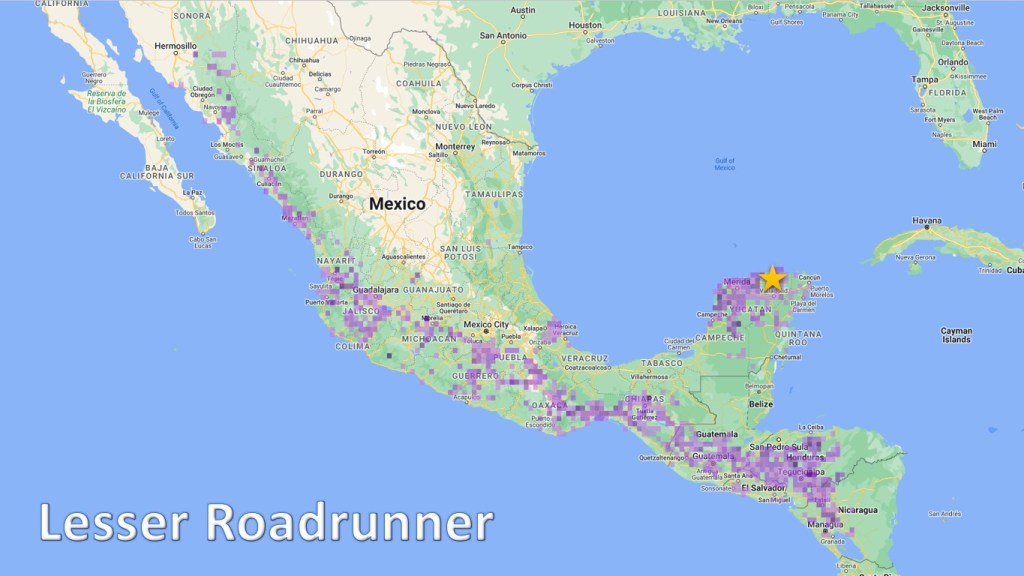
DETAILS ABOUT SIGHTING: We had been driving roads through the scrublands in northern Yucatan in all the appropriate habitats looking for this species. Finally, after over 2 hours we spotted one way ahead of us on the side of the road. It didn’t allow us to get any closer and the three shots I took was all it offered.
PHOTOS TAKEN: Image @ Carretera El Tajo, Yucatan, MX

ABOUT THE AREA: The northern regions of the State of Yucatan are composed of Yucatan Dry Forests where the climate is tropical subhumid with a long dry season. The average annual rainfall in this ecoregion does not exceed 1,200 mm per year. Dominant vegetative species in the central portion of the region include wild tamarind and Jamaican dogwood trees. They are often intermixed with other tree species such as Spanish cedar, gumbo-limbo, dryer’s mulberry, and Spanish elm. In the northern part of the ecoregion, near the coast, cacti become more abundant. The dry forests of Yucatán constitute a unique island of vegetation in the Gulf of Mexico region. They are isolated from other dry forests by the sea and by a vast extension of moist forests in the Maya region.

Miguel Amar Uribe, Claudio Lopez, Santiago Contreras and I spent the morning and early afternoon in search of several of the Yucatan specialty birds that can occur in these dry forests; such as Yucatan Poorwill, Yucatan Wren, Yucatan Woodpecker, Yucatan Flycatcher, Yucatan Vireo, Mexican Sheartail, Yucatan Gnatcatcher and Orange Oriole. Over the course of the next 7 hours we would find 15 new “Lifers” for me.
Previous 3 posts in my LIFER Blog Series.


 Reflections of the Natural World
Leave a comment