
| Saskatchewan’s slogan, “The Land of Living Skies” could refer as much to its magnificent birdlife as it does to its awe-inspiring Northern Lights and spectacular thunderstorms experienced there. This centrally located Canadian Province’s “Land of Living Skies” is home to over 400 recorded oiseaux (Fr. bird) species. Using my personal photographs in a blog post format, viewers will learn about the natural history and conservation status of these interesting birds in the Land of Living Skies! A Reflections of the Natural World Blog Post Series by Jim Gain |

WHAT’S IN A NAME
Common Loon – Gavia immer
Name roots: (L. gavia, “gull”; E. immer, “diver”)
PHYSICAL CHARACTERISTICS
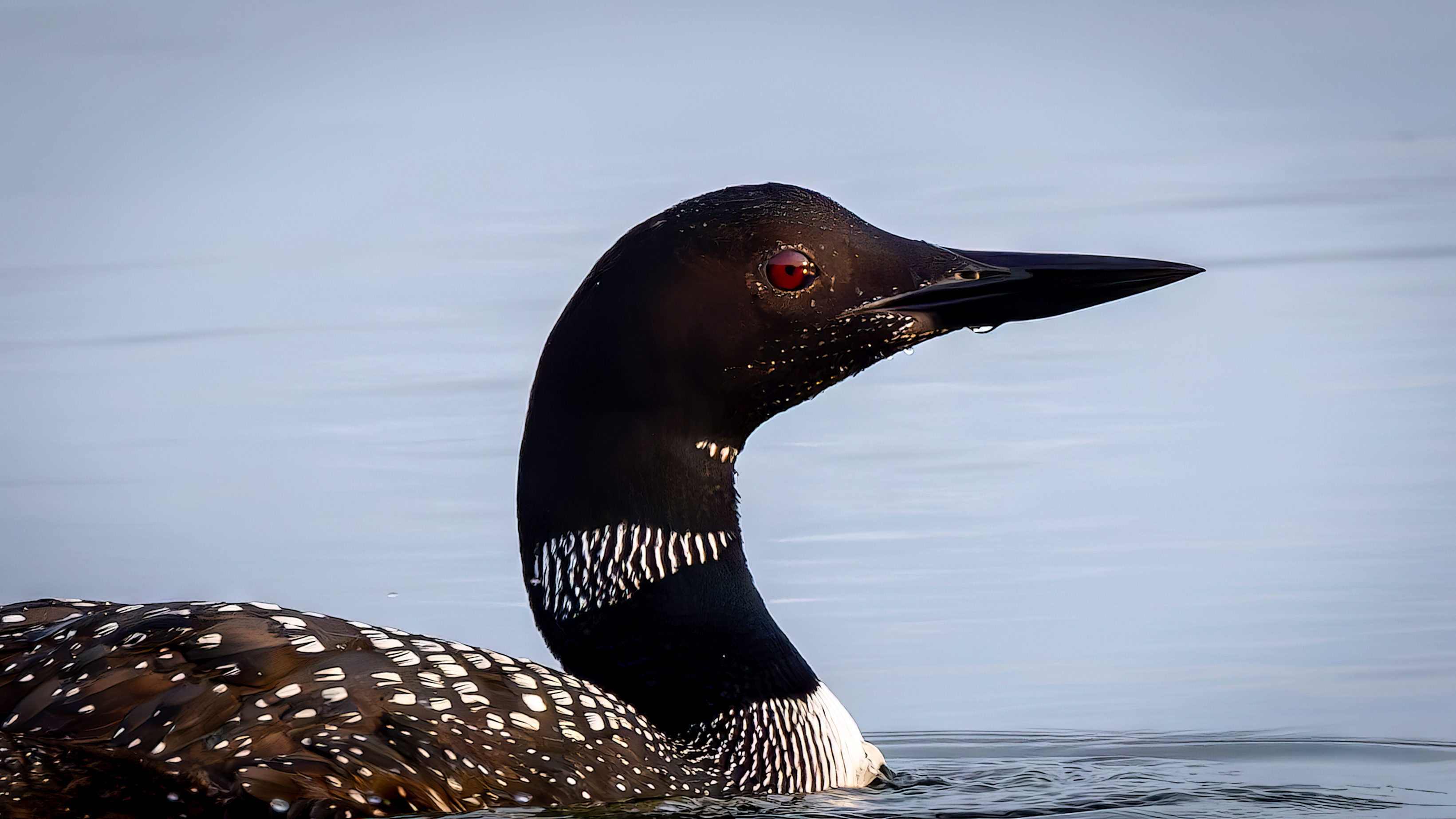
The Common Loon is a large, diving waterbird with a rounded head and dagger-like bill. It has a long body and short tail that is usually not visible. In flight, it looks stretched out, with a long, flat body and long neck and bill. The Common Loon has a black-and-white checkered back, a black bill, red eyes, an outsized white “necklace” marking around the neck, and a much smaller white “chinstrap” marking at the throat when it is in breeding plumage.

Common Loons reach a size of 28 to 32 inches (71 to 81 centimeters) in length with a wingspan of about 46 inches (117 centimeters). They can weigh between 9 and 12 pounds (4 and 5.5 kilograms). Males are generally larger than females.

DISTRIBUTION & OCCURENCE IN THE LAND OF LIVING SKIES
Common Loons prefer freshwater lakes and ponds with clear water and rocky shorelines. They are found throughout Saskatchewan.

eBird Bar Charts & Map Grid


CONSERVATION STATUS – International Union for Conservation of Nature (IUCN) Red List Category
The Common Loon is classified as Least Concern by the IUCN.
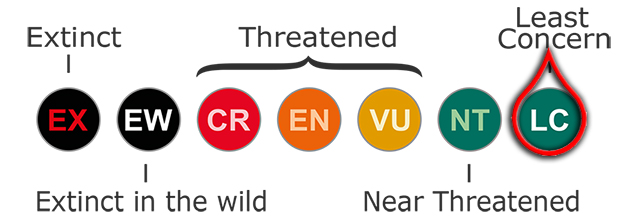
Redlist Classification Justification: This species has an extremely large range, the population trend appears to be stable, and the population size is very large. For these reasons the species is evaluated as Least Concern.
Leave a Reply