By Jim Gain

Learn 100 Common Valley Birds is a photo blog series highlighting the 100 most common Valley bird species.
Post #26 in the Learn 100 Common Valley Birds series. (Species 42, & 43/100)
Red-necked Phalarope #42

The Red-necked Phalarope (Phalaropus lobatus) is a small migratory bird that can be observed in the Central Valley of California during the spring and fall migration seasons. Like other phalaropes, it is a polyandrous species in which sex roles are reversed; breeding females are distinguishable by brighter plumage than males and by slightly larger body size. This bird measures around 7 inches in length and has a distinctive appearance, with a dark back, white belly, and reddish neck and throat. During the breeding season, the female takes on a brighter plumage than the male, with a more intense red neck and a darker back.

The Red-necked Phalarope is a highly specialized bird that spends most of its life at sea. It is known for its unique feeding behavior, where it spins in circles on the water’s surface to create a whirlpool, which draws in small prey, such as crustaceans and plankton. During migration, these birds can be found in shallow wetlands, flooded fields, and other areas with shallow water, where they forage for food.

In Basic (nonbreeding) plumage of both sexes includes a white head with a conspicuous black line through and behind the eye, a dark patch on the back of the crown or nape, white underparts that occasionally have gray smudges on the sides of the breast and flanks, and gray upperparts with white fringes along the scapular and mantle margins.
Red-necked Phalaropes breed in the Arctic tundra and migrate long distances to their wintering grounds in the Pacific Ocean. The Central Valley of California serves as an important stopover site for these birds during their migration, providing a critical source of food and habitat as they travel between their breeding and wintering grounds.
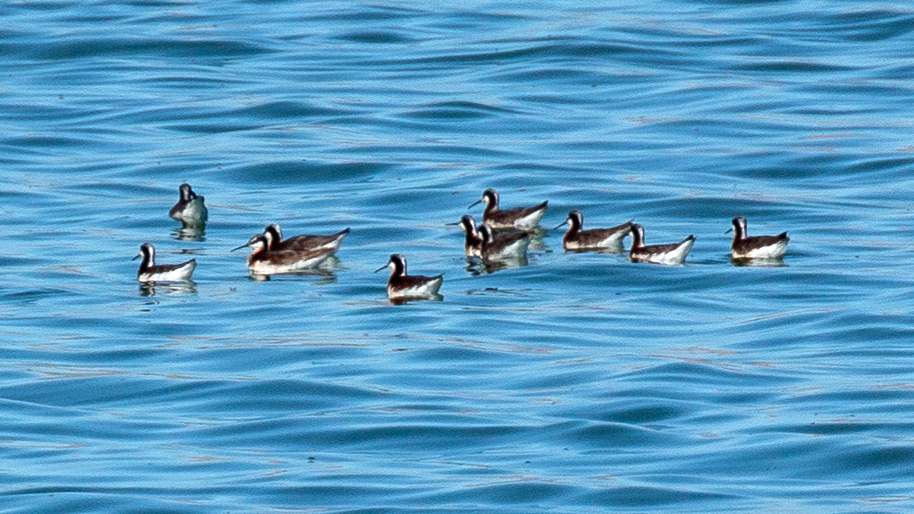
Wilson’s Phalarope #43

The Wilson’s Phalarope (Phalaropus tricolor) is a unique and beautiful shorebird species that can be found in the Central Valley of California during its annual migration. Adults have a distinctive plumage with a grayish-brown back and wings, white underparts, and a reddish neck and breast. However, during breeding season, the females become more colorful, with a bright rusty-red back and wings.

Wilson’s Phalaropes are well-adapted to their wetland habitats, where they feed on small aquatic invertebrates by spinning in circles on the water’s surface, creating a vortex that draws prey towards their bills. They are also notable for their breeding behavior, where females take on a more dominant role, courting and defending multiple males while the males incubate the eggs and care for the chicks.

While the Central Valley of California provides important stopover habitat for Wilson’s Phalaropes during migration, this species faces threats from habitat loss and degradation due to agriculture, drought, and climate change. Conservation efforts such as wetland restoration and protection are crucial to ensuring the survival of this unique and fascinating bird.
Previous posts from the Learn 100 Common Valley Birds series:


Leave a Reply