
Charadrius vociferus
By Jim Gain

Learn 100 Common Valley Birds is a photo blog series highlighting the 100 most common Valley bird species.
Post #9 in the Learn 100 Common Valley Birds series. (Species 14/100.)
Status
The Killdeer is a Common Resident to California’s Central Valley. Killdeer belong to the plover family (Charadriidae) with 68 species worldwide. As their Latin specific epithet name indicates, they are quite noisy (vociferous).

Description
The Killdeer’s upperparts are mostly brown with white underparts. Their upper chest is interrupted by 2 black bands. The sexes are monomorphic (alike) and plumages are essentially identical throughout year.
Distribution
Killdeer can be found from Canada, south all the way to the coastal areas of Peru. In California’s Central Valley, Killdeer can be found in close proximity to humans, often in schoolyards, parks and businesses with dirt lots.
Nests and Young
Killdeer nests are located on mostly flat, gravelly open areas with little to no nesting material visible. They are also known to nest on flat graveled rooftops and parking lots. Killdeer young are precocial vs altricial at birth. A precocial bird is “capable of moving around on its own soon after hatching.” The word comes from the same Latin root as “precocious.” Altricial means “incapable of moving around on its own soon after hatchling.” It comes from a Latin root meaning “to nourish” a reference to the need for extensive parental care

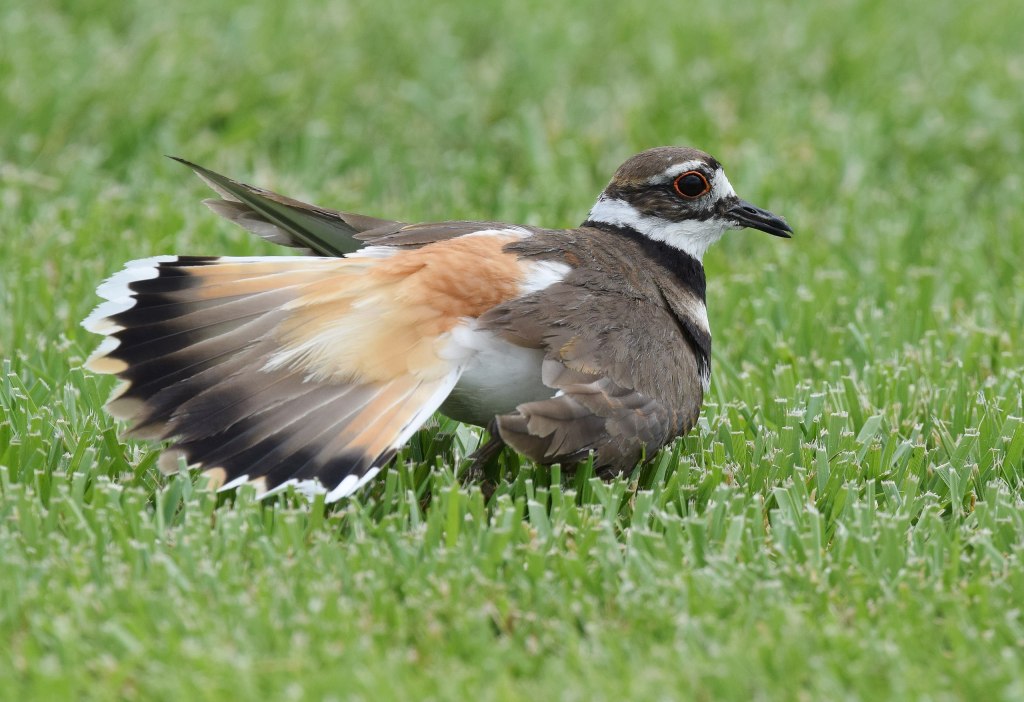
Habits – Injury-Feigning Display
Performed by either sex, usually by only 1 member of pair at a time. If both members of pair are present, one usually gives alarm calls from a distance. In response to potential predator, bird crouches, head low, breast-bands minimally showing, wings drooping and partially extended, sometimes flapping to beat against the ground, tail fanned and dragging the ground to display rufous rump-patch. Displaying bird’s body is usually oriented away from potential predator, but its head is turned to the side such that the bird looks over its shoulder at potential predator.
Similar Species
There is another breast-banded plover species similar to the Killdeer that can be found in the valley during spring and fall migration. The Semipalmated Plover has mostly the same coloration and marking except that it only has one band across its breast and it is a smaller species.
Check out the comparison between the two species below.


Previous posts from the Learn 100 Common Valley Birds series,

 Reflections of the Natural World
Leave a reply to Killdeer – Reflections of the Natural World – Cancel reply