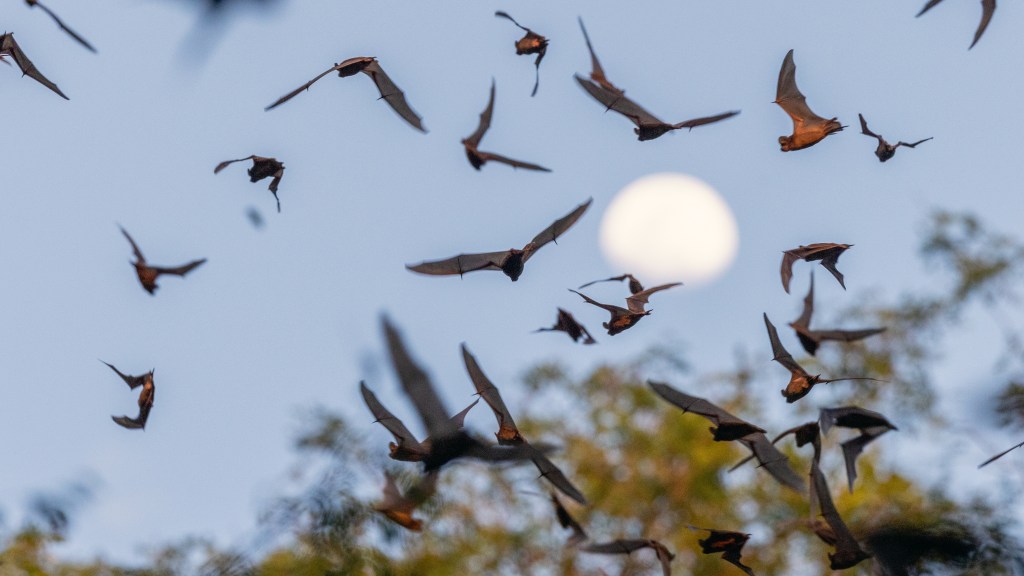

Taking a slight deviation from my theme of Yucatan Birds, one of the biggest Holy Guacamole moments was actually of a different kind of flying vertebrate – bats. Deep in the forests of southern Campeche is a unique natural protected area known as “Zona Sujeta a Conservación Ecológica Balam-Kú” in Calakmul Municipality. This ecological area is home to “El Volcán de los Murciélagos”.

There are seven bat caves known in Mexico, but this is the only one featuring a visual volcano of erupting chiropterans. In fact, it is one of only two know to exist in the entire world. The second one being in Malasia.
There have been 9 bat species identified in this cave with one being nectivorous,
- Pallas’ Long-tongued Bat – Glossophaga soricina,
and the others insectivorous.
- Davy’s (lesser) Naked-backed Bat – Pteronotus davyi,
- Big Naked-backed Bat – P. gymnonotus,
- Parnell’s Mustached Bat – P. parnellii,
- Wagner’s Mustached Bat – P. personatus,
- Ghost-faced Bat – Mormoops megalophylla,
- Mexican Funnel-eared Bat –Natalus stramineus,
- Hairy-legged Myotis Bat – Myotis keaysi
- and Broad-eared Bat – Nyctinomops laticaudatus).
Over the years a 130-feet-deep landslide has formed due to rainfall and erosion. At the bottom of this landslide there is a cave with an entrance 400 feet wide and 500 feet deep, at its longest with a depth of almost 2,000 feet. Every afternoon, approximately between 5 and 6 pm, “the volcano”, erupts with between three and four million bats as if they were lava. From the first handful of emerging bats, the eruption can last up to 90 minutes until the last bat leaves its roost.
SENSORY OVERLOAD
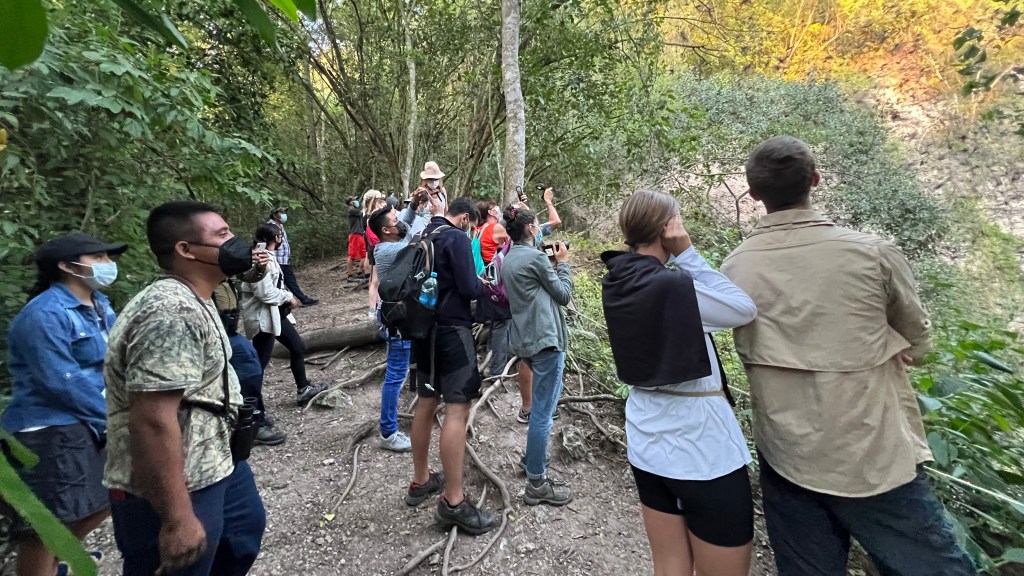
Hushed conversations in Spanish, French, English and German coming from the small group of ecotourists that were gathered with much excitement in anticipation of this living volcano of bats. Standing on the edge of this expansive grotto, the quiet conversations seemed to be absorbed by the mysterious and beautiful setting. Suddenly the talking stopped as the first handful of bats flew right past our observation point – “Here they come!”
My mind tried to envision what the guide said would be almost 8 million bats erupting from the cave. At first, a few dozen began to circle around the opening, slowly rising higher and higher. Gradually the numbers grew, slowly at first and then increasing almost exponentially. Dozens became hundreds became thousands became MILLIONS. ABSOLUTLEY INCOMPREHENSIBLE.
Soon, the cave walls resonated with the sound of a million tiny bat wings flapping mightily to rise into the jungle sky. Creating their own mini-weather system, the circling bats generated a funnel of rising winds, laden with the sulphureous odor of uncountable tons of bat guano.
Links to more details
Conservación de Murciélagos en Campeche


 Reflections of the Natural World
Leave a reply to ericcaine Cancel reply