
**Due to the high resolution and quality of the images in this blog series it is highly recommended
that readers view posts in Landscape Mode on a desktop PC from the actual blogsite at Ecuador Birding**

Ecuador Birding – Where Every Feather Tells a Story
From October 26, 2025 through November 8, 2025 I joined 5 other adventurers and an outstanding photographer and birding guide (Liron Gertsman) with Eagle-Eye Tours to Ecuador. This blog series highlights the animals (mostly birds), people and locations we encountered over the 14 full days in this beautiful land.
A Reflections of the Natural World Blog Post Series by Jim Gain
DAY 7 – Early Morning
- My Ecuador Species Count through the morning at Cabañas San Isidro jumps up to: 239 (168 lifers)
- Primary eBird Public Hotspots:
Cabañas San Isidro sits deep in the eastern Andean foothills, a place where cloudforest drips with moss and every dusk feels alive with mystery. The lodge has become famous not only for its rich birdlife but also for its long‑running enigma—the so‑called San Isidro Owl, a Black‑banded Owl look‑alike that still sparks debate among ornithologists. That night, its haunting calls drifted through the forest, joined by the guttural dawn‑booms of Wattled Guans, both species close enough to hear yet elusive enough to evade every camera. By first light, while the rest of the group slept, I made my way to the moth lights—bright panels left running overnight to attract insects, which in turn draw in an astonishing parade of early‑morning birds. Standing there in the cool mist, I felt like I had front‑row seats to the forest’s daily unveiling.

The first visitor was the Montane Woodcreeper, a slender, cinnamon‑brown climber that spiraled up trunks with quiet determination. Its long, slightly decurved bill probed into bark crevices as it searched for insects stunned by the night’s lights. When it paused, its streaked throat and subtle facial markings glowed softly in the dawn light, giving this otherwise understated bird a quiet elegance. Soon after, a Swainson’s Thrush hopped into view, its warm buffy eye‑ring and spotted breast instantly recognizable. This species is a long‑distance migrant, traveling from North America to winter in these very forests, and seeing it here—far from home—always feels like meeting an old friend in an unexpected place.


The understory then came alive with the quick, restless movements of the Gray-breasted Wood-Wren, a tiny bird with a huge voice. Its rich, cascading song echoed through the clearing, far louder than its size would suggest. It darted between branches with tail cocked high, pausing only long enough for its gray breast and barred flanks to catch the light. Moments later, the Olive-backed Woodcreeper appeared, darker and more robust than the earlier Montane Woodcreeper. Its olive‑brown plumage blended perfectly with the mossy trunks, and its methodical, almost mechanical climbing style made it seem like a creature carved from the forest itself.


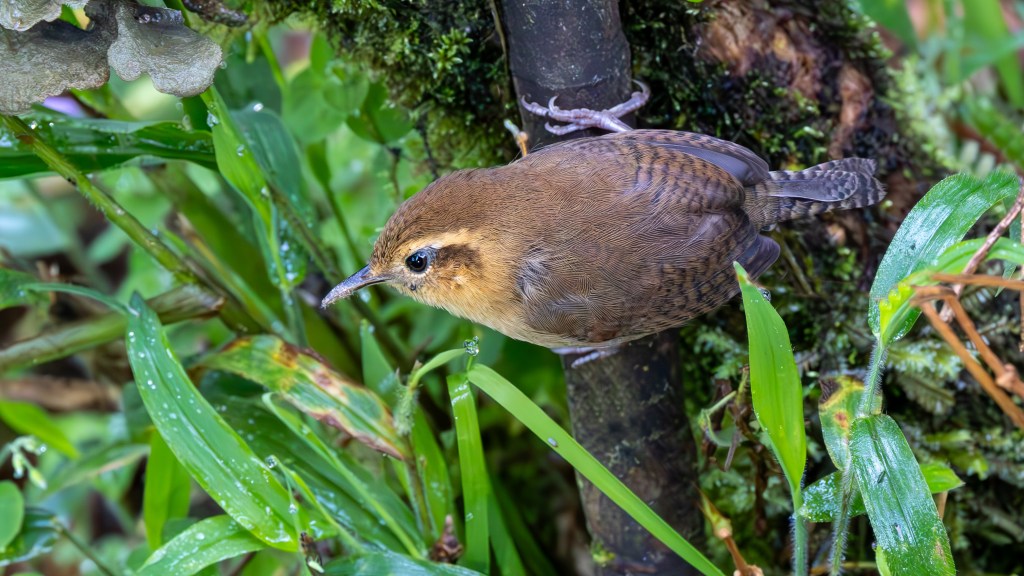
As the sun climbed, the moth lights continued to draw in new arrivals. A Mountain Wren emerged from the shadows, its rich brown plumage and bold supercilium giving it a surprisingly expressive face. Unlike many wrens, it moved with a calm, almost deliberate curiosity, inspecting the moth‑covered panels with soft, fluttering hops.
The Golden-bellied Flycatcher followed, a burst of yellow energy that perched boldly on exposed branches. Its bright belly and contrasting dark mask made it stand out even in the dim morning light, and its sharp, snappy sallies for insects added a lively rhythm to the scene.

The final wave brought some of the morning’s most memorable species. A Black‑eared Hemispingus appeared in a mixed flock, its olive body and distinctive black ear patch giving it a sharp, alert expression. It moved quickly through the branches, pausing only long enough to snatch insects drawn to the lights. Nearby, a Common Chlorospingus flitted through the lower tangles, its warm olive tones and expressive face giving it the look of a bird perpetually curious about everything around it.


A Pale‑edged Flycatcher followed, sallying out from a shaded perch to grab moths and beetles still lingering from the night, its pale wing edgings catching the soft morning light each time it darted forward.


A short while later, we walked a brief distance down a narrow trail, led by one of the Cabañas guides to a small clearing where the White‑bellied Antpitta is known to appear. At the simple feeding station, he placed several worms on a mossy log and stepped back. For a moment, the forest held its breath. Then, with the quiet confidence of a bird that knows it is rarely seen, the antpitta hopped into view. Plump, round, and impossibly endearing, it moved with delicate, deliberate steps, its clean white belly glowing against the dark understory and its warm brown upperparts blending seamlessly with the leaf litter. For a few precious seconds, it allowed us to admire a species that most birders only ever hear—an intimate, unforgettable encounter with one of the cloudforest’s most secretive residents.


Little did I know that the next chapter of this journey would bring an even bolder burst of color: the dazzling “Inca” Green Jay, a bird so striking it deserves a story all its own.
NEXT UP: EB#41 “Same Jay, New World: Discovering the Inca Green Jay of Ecuador“
Additional Photographs and Video


Previous Ecuador Birding Blog Posts:
- EB40 – Early Morning Wings at the Moth Light Feeders of Cabañas San Isidro
 In October 2025, Jim Gain joined a birding tour in Ecuador, exploring its rich biodiversity and stunning landscapes over 14 days. The blog series chronicles his experiences with birds and nature.
 - EB39 – Wildlife and Mountain Mists on the Road to San Isidro
 In October 2025, Jim Gain joined a birding tour in Ecuador, exploring its rich biodiversity and stunning landscapes over 14 days. The blog series chronicles his experiences with birds and nature.
 - EB38 – Sunlit Surprise: The Golden‑Tailed Sapphire’s Rainbow Glow
 In October 2025, Jim Gain joined a birding tour in Ecuador, exploring its rich biodiversity and stunning landscapes over 14 days. The blog series chronicles his experiences with birds and nature.
 - EB37 – The Numbers Keep Climbing: WildSumaco’s Hummingbird Explosion Continues
 In October 2025, Jim Gain joined a birding tour in Ecuador, exploring its rich biodiversity and stunning landscapes over 14 days. The blog series chronicles his experiences with birds and nature.
 - EB36 – From Farmland to Sanctuary: WildSumaco’s Rebirth and Its Earliest Arrivals
 In October 2025, Jim Gain joined a birding tour in Ecuador, exploring its rich biodiversity and stunning landscapes over 14 days. The blog series chronicles his experiences with birds and nature.
 - EB35 – Leaving the Amazon Behind, Rising into the Eastern Andes
 In October 2025, Jim Gain joined a birding tour in Ecuador, exploring its rich biodiversity and stunning landscapes over 14 days. The blog series chronicles his experiences with birds and nature.

>>Ecuador Birding Blog Home Page Link https://reflectionsofthenaturalworld.com/ecuador-birding/
*This Ecuador Birding blog post was shaped and polished with the assistance of Microsoft Copilot, helping bring clarity and a consistent flow to my field notes and dictated memories.
**Unless otherwise indicated in the image caption, all photographs (>99%) are mine.

 Reflections of the Natural World
Leave a comment