A Reflections of the Natural World Blog Post Series by Jim Gain

Ecuador Birding – Where Every Feather Tells a Story
From October 26, 2025 through November 8, 2025 I joined 5 other adventurers and an outstanding photographer and birding guide (Liron Gertsman) with Eagle-Eye Tours to Ecuador. This blog series highlights the animals (mostly birds), people and locations we encountered over the 14 full days in this beautiful land.
DAY 4 – Afternoon
- My Ecuador Species Count including the visit to El Retiro and San Roque jumps up to: 185 (130 lifers)
- Primary eBird Public Hotspots: Random
Because of the river’s extraordinary height, we were unable to bird the familiar grounds we had explored earlier in the trip. Instead, we turned downstream, heading toward the San Roque community, ready to see what the rising waters might reveal next. As we cruised downstream, the river revealed a landscape reshaped by the recent rains. Clumps of trees, branches, and tangled vegetation drifted in loose flotillas or lay grounded on shallow sandbars—each one a temporary micro‑habitat, a miniature raft of rainforest life. BLACK SKIMMERS swept past us in a tight flock, their long, knife‑like lower mandibles slicing the water’s surface with effortless grace. Their black‑and‑white plumage flashed sharply against the muddy river, and their strange, asymmetrical bills—so bizarre and so perfectly adapted—reminded me why I never tire of seeing them.

We slipped into quieter backwater channels where the forest pressed close. At one point we stepped off the Mama Lucy for a short walk along a Sani pathway. A ROADSIDE HAWK—broad‑shouldered and fierce‑eyed—watched us from a low perch, its barred chest puffed slightly as if assessing our intentions. Overhead, RED-BELLIED MACAWS wheeled in noisy, chattering groups, their emerald bodies and brick‑red bellies glowing against the gray sky.


Farther along, an ORIOLE BLACKBIRD flashed its glossy black plumage and bright orange shoulders from a distant treetop, while a YELLOW-TUFTED WOODPECKER clung to a trunk, its golden crown blazing like a tiny torch in the dim light. Orange‑winged Amazons passed overhead in raucous squadrons, their green bodies and bright wing patches flashing as they squawked their way across the canopy. An unusual SWALLOW-WINGED PUFFBIRD, with its sleek charcoal plumage and swallow‑like silhouette, rounded out our checklist before we climbed back aboard.


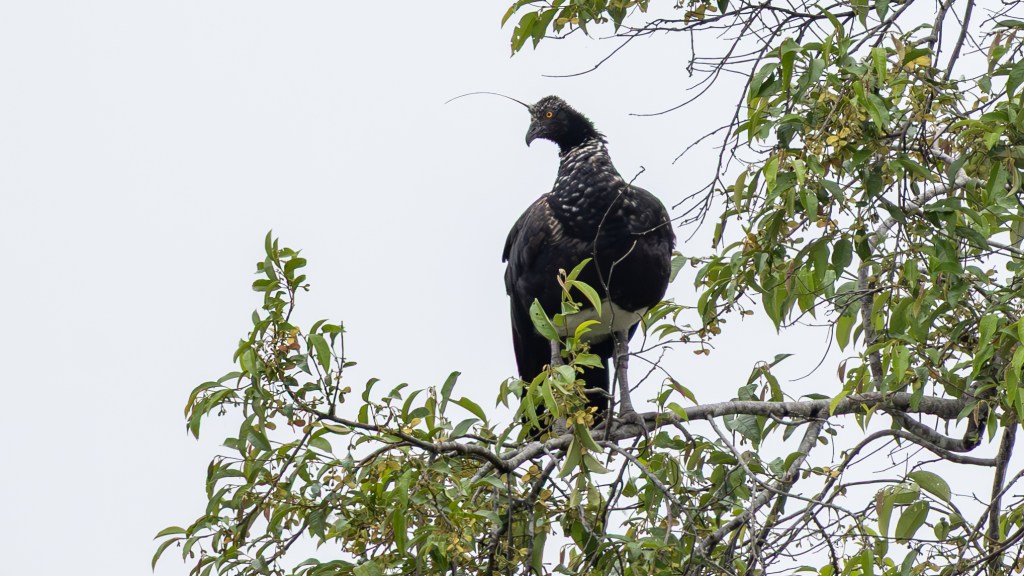
As we pushed off, Carlos pointed out a pair of HORNED SCREAMERS—massive, prehistoric‑looking birds with spiky crowns and thick, scaly legs. Their deep, resonant calls drifted across the water as they stood sentinel‑like on a flooded bank. ORANGE-WINGED AMAZONS passed overhead in raucous squadrons, their green bodies and bright wing patches flashing as they squawked their way across the canopy.


As we traveled down the broad, sediment‑laden sweep of the Napo River, the morning light kept shifting between silver and gold, catching on the waves kicked up by the Mama Lucy. It was along one of those long, open stretches that we spotted it — a LARGE-BILLED TERN perched on a sun‑bleached snag jutting from a sandbar. At first it looked like part of the driftwood itself, but then it lifted its head, that oversized yellow bill glowing against the muted tones of the river. We slowed the boat, drifting just enough to close the distance without startling it. For a moment, the tern held its ground, tall and elegant, the breeze ruffling its feathers as it scanned the water. But as we eased a little closer, it made its decision. With a sudden lift of wings, it launched into the air and skimmed upstream, flying low and fast along the channel until it vanished into the bright haze. It was a brief encounter, but one of those perfect river moments — a bird shaped by the restless water, offering us just a glimpse before returning to its wide, ever‑shifting world.


We continued downstream, stopping often to inspect the birds that had claimed the floating vegetation islands. Spotted Sandpipers, now in their clean winter plumage, bobbed their tails as they foraged along the edges. Collared and Pied Plovers patrolled the mats of debris, their crisp patterns and quick, darting movements giving them an air of perpetual alertness.
NEXT UP: EB#31 “Unexpected Sentinel: Burrowing Owl on a Floating Forest Island“
Additional Photographs


Previous Ecuador Birding Blog Posts:
- EB40 – Early Morning Wings at the Moth Light Feeders of Cabañas San Isidro
 In October 2025, Jim Gain joined a birding tour in Ecuador, exploring its rich biodiversity and stunning landscapes over 14 days. The blog series chronicles his experiences with birds and nature.
 - EB39 – Wildlife and Mountain Mists on the Road to San Isidro
 In October 2025, Jim Gain joined a birding tour in Ecuador, exploring its rich biodiversity and stunning landscapes over 14 days. The blog series chronicles his experiences with birds and nature.
 - EB38 – Sunlit Surprise: The Golden‑Tailed Sapphire’s Rainbow Glow
 In October 2025, Jim Gain joined a birding tour in Ecuador, exploring its rich biodiversity and stunning landscapes over 14 days. The blog series chronicles his experiences with birds and nature.
 - EB37 – The Numbers Keep Climbing: WildSumaco’s Hummingbird Explosion Continues
 In October 2025, Jim Gain joined a birding tour in Ecuador, exploring its rich biodiversity and stunning landscapes over 14 days. The blog series chronicles his experiences with birds and nature.
 - EB36 – From Farmland to Sanctuary: WildSumaco’s Rebirth and Its Earliest Arrivals
 In October 2025, Jim Gain joined a birding tour in Ecuador, exploring its rich biodiversity and stunning landscapes over 14 days. The blog series chronicles his experiences with birds and nature.
 - EB35 – Leaving the Amazon Behind, Rising into the Eastern Andes
 In October 2025, Jim Gain joined a birding tour in Ecuador, exploring its rich biodiversity and stunning landscapes over 14 days. The blog series chronicles his experiences with birds and nature.

>>Ecuador Birding Blog Home Page Link https://reflectionsofthenaturalworld.com/ecuador-birding/
*This Ecuador Birding blog post was shaped and polished with the assistance of Microsoft Copilot, helping bring clarity and a consistent flow to my field notes and dictated memories.
**Unless otherwise indicated in the image caption, all photographs (>99%) are mine.

 Reflections of the Natural World
Leave a comment