A Reflections of the Natural World Blog Post Series by Jim Gain

Ecuador Birding – Where Every Feather Tells a Story
From October 26, 2025 through November 8, 2025 I joined 5 other adventurers and an outstanding photographer and birding guide (Liron Gertsman) with Eagle-Eye Tours to Ecuador. This blog series highlights the animals (mostly birds), people and locations we encountered over the 14 full days in this beautiful land.
DAY 4 – Afternoon
- My Ecuador Species Count including the entire day at Sani Lodge and Canopy Tower jumps up to: 162 (114 lifers)
- Primary eBird Public Hotspots: Sani Lodge
As the drizzle eased again, a sudden flare of red caught our attention near the edge of the clearing. A MASKED CRIMSON TANAGER had emerged from the shadows, its deep crimson plumage glowing like a drop of molten color against the dark, rain‑soaked foliage. The bird’s black facial mask gave it a bold, almost theatrical expression, as though it were wearing a tiny bandit’s hood. It moved with quick, purposeful hops along a tangle of wet branches, pausing only long enough for the rain to bead on its feathers like scattered rubies. Even in the muted light, the tanager radiated an intensity that seemed to brighten the entire understory.

Not far from where the crimson tanager had appeared, a SILVER‑BEAKED TANAGER materialized next, stepping into view with a quiet confidence that contrasted beautifully with its fiery neighbor. Its velvety maroon plumage absorbed the soft light, giving it a rich, wine‑dark glow, while its gleaming silver bill shone like polished metal each time it turned its head. As it flicked droplets from its wings, a female Silver‑beaked Tanager fluttered in beside it, her softer brownish‑gray tones and subtler facial markings offering a gentle counterpoint to the male’s dramatic palette. Though less boldly colored, she carried a delicate beauty of her own—her understated hues blending seamlessly with the rain‑dampened foliage as she foraged with quick, efficient movements. Together, the pair created a striking tableau of contrast and harmony, a reminder that even within a single species, the forest paints with a wide and thoughtful brush.


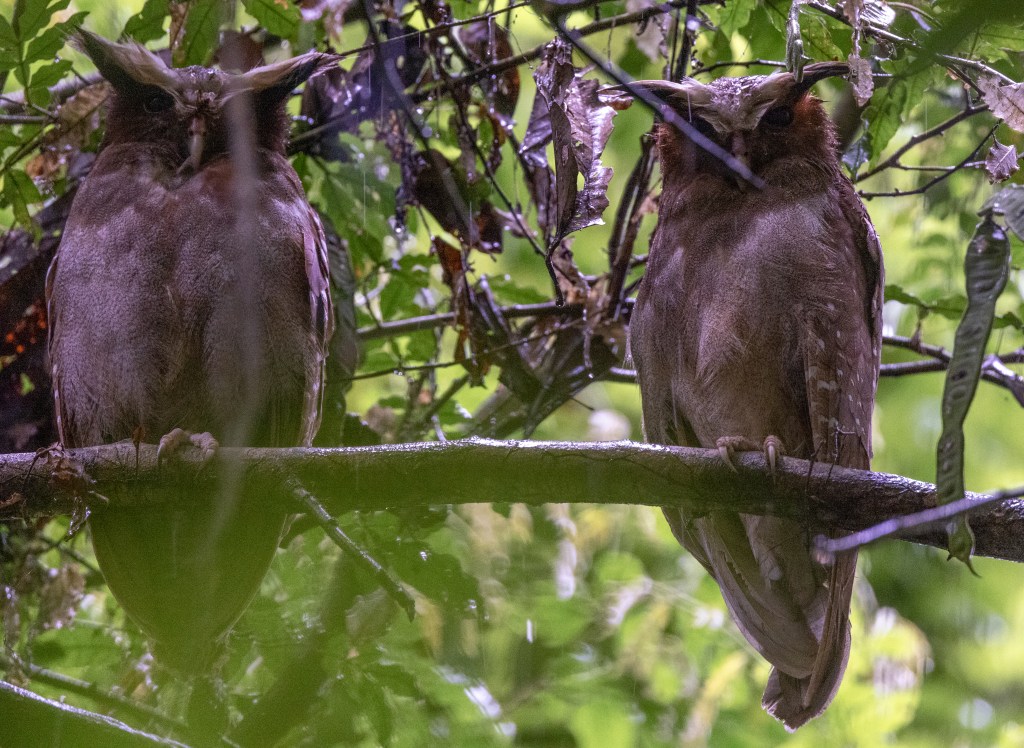
While I was photographing the Silver-beaked Tanagers, Liron called out again—this time with real urgency. Tucked deep in the dim tangle of understory vines, a pair of CRESTED OWLS sat motionless on a thick horizontal branch, their long white ear tufts rising like delicate plumes against the shadows. At first they seemed like carved ornaments—two pale‑faced sentinels with dark, penetrating eyes that absorbed what little light filtered through the canopy. As we watched, one slowly blinked, revealing the soft buff wash around its face and the intricate barring along its chest, details that seemed to materialize only when the bird allowed them to. In the Ecuadorian Amazon Lowlands, Crested Owls are masters of concealment, spending their days roosting in dense, shaded thickets where their cryptic plumage blends seamlessly with the gloom. They often return to the same roost for days or even weeks at a time, relying on stillness and shadow rather than height for protection. Seeing them so clearly—two ghostlike figures perched in perfect symmetry—felt like stumbling upon a secret the forest rarely shares.

Later in the afternoon, Carlos and Vladimir offered to take us out on the lagoon for a short cruise, and we eagerly accepted. The rain had paused, though we wisely kept our gear close at hand.

As the clouds thinned once more, a duet of sharp, bubbling notes rose from the marshy edge of the lodge grounds. Following the sound, we soon spotted a BLACK‑CAPPED DONACOBIUS perched boldly atop a tangle of reeds, its glossy black crown and rich tawny body glowing against the fresh wash of green. The bird flicked its long tail with theatrical emphasis, pausing between calls as if waiting for an unseen partner to answer. In the Amazon Lowlands, donacobius pairs are famous for their synchronized duets—complex, antiphonal exchanges that strengthen pair bonds and proclaim territory with surprising volume. Even in the soft drizzle, this individual radiated charisma, its bright yellow eyes flashing with each emphatic note as it surveyed the wetland like a tiny, self‑appointed conductor of the morning chorus.

As the light strengthened and the forest shook off another passing shower, a splash of electric color zipped into view—a male YELLOW‑BELLIED DACNIS, glowing like a tiny gemstone against the freshly washed canopy. His sapphire‑blue head and back shimmered with iridescence, while his bright yellow belly flashed each time he pivoted to inspect a cluster of berries. Moments later, a female joined him, her olive‑green tones far subtler but no less elegant, blending beautifully with the rain‑dampened foliage as she foraged with quick, precise movements. The pair moved with a restless, hummingbird‑like energy, weaving through the dripping leaves in short, darting flights that left brief trails of color in the softened morning light. For a few moments, their presence transformed the clearing into a living palette—proof that even after the heaviest rains, the Amazon never loses its brilliance.

As we continued along the dripping forest edge, another movement caught our eye—a STRAIGHT‑BILLED WOODCREEPER inching its way up a moss‑covered trunk with deliberate, methodical steps. Its long, slender bill traced the bark with practiced precision, probing crevices for insects hidden by the rain. Compared to the cinnamon‑toned species we’d seen earlier, this woodcreeper carried a more understated elegance: warm brown plumage streaked subtly along the throat and breast, blending seamlessly with the damp, textured bark. Every few seconds it paused, lifting its head to assess the next stretch of trunk before hitching upward in a smooth, fluid motion. In the soft post‑rain light, the bird looked like a quiet artisan of the forest, working its way through the vertical world with calm, purposeful focus.

A sudden splash from the lagoon drew our attention next, just in time to see a massive RINGED KINGFISHER rise from the water with a powerful, rattling call that echoed across the clearing. It landed on a low, rain‑darkened branch, shaking droplets from its slate‑blue wings and revealing the bold chestnut band across its belly. The bird’s heavy, dagger‑like bill and commanding posture gave it an almost regal presence as it scanned the shallows for another strike. In the muted light, the kingfisher looked carved from the river itself—broad‑shouldered, purposeful, and utterly at home in the watery world below. For a moment, it sat motionless, the rain beading on its crest like tiny jewels, before launching off again in a swift, decisive arc that left only ripples and silence in its wake.

NEXT UP: EB#29 “Navigating the Flooded River on Our Way Back to El Retiro“
Additional Photographs and Video


Previous Ecuador Birding Blog Posts:
- EB39 – Wildlife and Mountain Mists on the Road to San Isidro
 In October 2025, Jim Gain joined a birding tour in Ecuador, exploring its rich biodiversity and stunning landscapes over 14 days. The blog series chronicles his experiences with birds and nature.
 - EB38 – Sunlit Surprise: The Golden‑Tailed Sapphire’s Rainbow Glow
 In October 2025, Jim Gain joined a birding tour in Ecuador, exploring its rich biodiversity and stunning landscapes over 14 days. The blog series chronicles his experiences with birds and nature.
 - EB37 – The Numbers Keep Climbing: WildSumaco’s Hummingbird Explosion Continues
 In October 2025, Jim Gain joined a birding tour in Ecuador, exploring its rich biodiversity and stunning landscapes over 14 days. The blog series chronicles his experiences with birds and nature.
 - EB36 – From Farmland to Sanctuary: WildSumaco’s Rebirth and Its Earliest Arrivals
 In October 2025, Jim Gain joined a birding tour in Ecuador, exploring its rich biodiversity and stunning landscapes over 14 days. The blog series chronicles his experiences with birds and nature.
 - EB35 – Leaving the Amazon Behind, Rising into the Eastern Andes
 In October 2025, Jim Gain joined a birding tour in Ecuador, exploring its rich biodiversity and stunning landscapes over 14 days. The blog series chronicles his experiences with birds and nature.
 - EB34 – One Last Cruise Around the Calluacocha Lagoon
 In October 2025, Jim Gain joined a birding tour in Ecuador, exploring its rich biodiversity and stunning landscapes over 14 days. The blog series chronicles his experiences with birds and nature.

>>Ecuador Birding Blog Home Page Link https://reflectionsofthenaturalworld.com/ecuador-birding/
*This Ecuador Birding blog post was shaped and polished with the assistance of Microsoft Copilot, helping bring clarity and a consistent flow to my field notes and dictated memories.
**Unless otherwise indicated in the image caption, all photographs (>99%) are mine.

 Reflections of the Natural World
Leave a comment