
A Reflections of the Natural World Blog Post Series by Jim Gain

Ecuador Birding – Where Every Feather Tells a Story
From October 26, 2025 through November 8, 2025 I joined 5 other adventurers and an outstanding photographer and birding guide (Liron Gertsman) with Eagle-Eye Tours to Ecuador. This blog series highlights the animals (mostly birds), people and locations we encountered over the 14 full days in this beautiful land.
DAY 4 – Afternoon
- My Ecuador Species Count including the entire day at Sani Lodge and Canopy Tower jumps up to: 162 (114 lifers)
- Primary eBird Public Hotspots: Sani Lodge
With the Wire‑tailed Manakin still glowing in our minds, we made our way back toward the canoe landing, the rain drumming steadily on our hoods. By the time we reached the water’s edge, the downpour had eased just enough for us to climb aboard and begin the quiet ride back to the lodge. Even in the rain‑softened light, the birds continued to reveal themselves. A WATTLED JACANA tiptoed across floating vegetation with its impossibly long toes, while a stately Cocoi Heron stood tall and pale against the dark water.

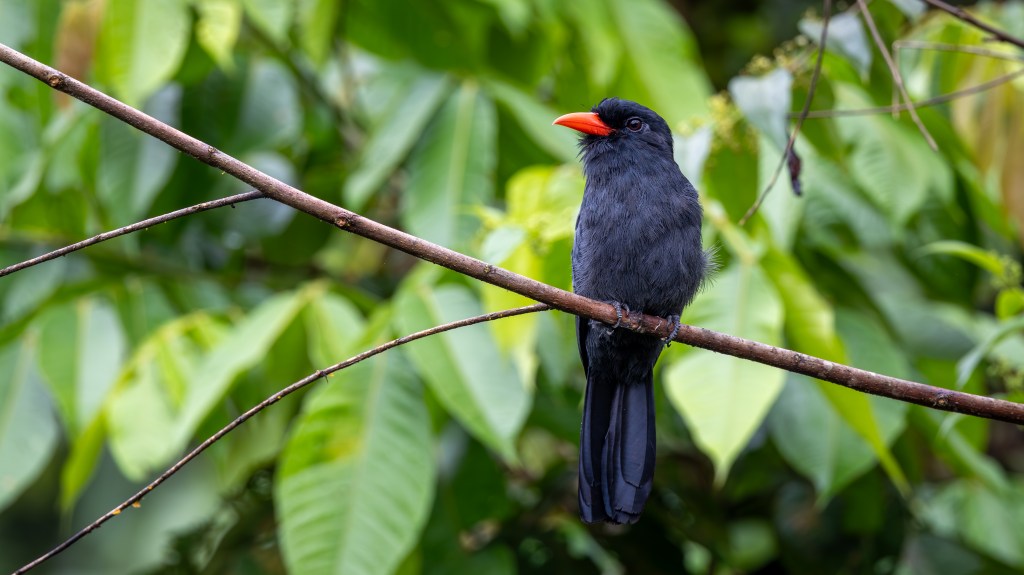
Back at the lodge, the rain settled into a rhythm of heavy bursts and brief respites, giving us pockets of time to explore the grounds with our cameras. During one of these breaks, Liron spotted a BLACK‑FRONTED NUNBIRD perched calmly on an open branch, its charcoal plumage and bright coral bill glowing against the wet greenery. The bird sat with regal stillness, raindrops beading on its sleek feathers as if polished onto the surface, while its fiery bill seemed almost illuminated in the muted forest light. Every so often it flicked its tail or gave a soft, hollow wuk call—an understated sound that contrasted beautifully with its bold appearance. For a few lingering moments, the nunbird held its pose like a carved obsidian figurine set against the dripping foliage, offering us a rare, unrushed look at one of the forest’s most striking understory sentinels.
A few minutes later, he pointed out a motionless CINNAMON‑THROATED WOODCREEPER, perfectly camouflaged against the trunk it clung to. At first it looked like nothing more than an extension of the bark itself—its warm cinnamon tones blending seamlessly with the ridged, moss‑flecked surface of the tree. Only when it shifted its head ever so slightly did the illusion break, revealing the long, decurved bill and subtle scaling along its throat and breast. The bird held its position with quiet determination, relying on stillness rather than secrecy, as if trusting the forest to hide it in plain sight. Even in the soft drizzle, its plumage carried a muted glow, a reminder that some of the Amazon’s most remarkable creatures are the ones that choose not to be seen.

Just as the woodcreeper melted back into the bark, a sudden flicker of movement drew our eyes upward. There, perched boldly on a rain‑darkened branch, was a brilliantly colored SCARLET‑CROWNED BARBET, its fiery red crown blazing like a live ember against the dripping canopy. The bird’s thick, chisel‑shaped bill and bold black mask gave it a striking, almost sculptural presence, while its emerald wings and lemon‑yellow belly glowed with saturated color in the soft, post‑rain light. It sat with a quiet confidence, occasionally tilting its head to inspect a nearby cluster of berries, the droplets clinging to its crown catching the light like tiny sparks. For a few unforgettable moments, the barbet seemed to radiate its own weather‑proof brilliance—an unexpected jewel emerging from the forest’s damp hush.

For the next hour, I wandered the lodge paths, photographing birds as they appeared between showers. Not long after the barbet slipped back into the foliage, a raucous chorus erupted from the treetops as a flock of YELLOW‑RUMPED CACIQUEs swept in to inspect the clearing. Their glossy black plumage contrasted sharply with the brilliant yellow patches on their rumps and wings, flashes of color that seemed to ignite whenever they shifted positions. One male took center stage, delivering a bubbling, mechanical song while flicking his wings in a theatrical display that felt equal parts courtship and bravado. Even in the lingering drizzle, the caciques brought an electric energy to the lodge grounds, their constant motion and chatter animating the forest’s damp hush.

Trailing behind the caciques came a hulking GIANT COWBIRD, its imposing size and glossy purple‑black sheen giving it a presence that was impossible to ignore. It perched high on an exposed branch, surveying the commotion below with a slow, deliberate confidence, as though weighing whether to join the fray. When it finally shifted, the bird revealed its long, powerful bill and heavy frame—traits that set it apart from the smaller blackbirds flitting around it. For a moment, the cowbird’s deep, resonant call rolled across the clearing, a low note that seemed to vibrate through the wet air before it launched off in a broad, unhurried glide.

Down near the edge of the lawn, a small group of SMOOTH‑BILLED ANIs huddled together on a rain‑soaked shrub, their communal posture giving them the look of a cluster of damp, black leaves. Their soft, whining calls drifted through the clearing as they shuffled for position, each bird trying to claim the warmest spot in the group. The smooth, arched profile of their oversized bills stood out even in the dim light, giving them a slightly prehistoric appearance. When a brief shaft of sunlight broke through the clouds, the anis responded instantly—spreading their wings to dry and revealing subtle iridescent tones hidden beneath their otherwise sooty plumage.

A sudden burst of yellow and brown announced the arrival of a LESSER KISKADEE, which darted out from a low perch to snatch an insect mid‑air before returning to its lookout with a triumphant flick of its tail. Unlike its louder, more boisterous Great Kiskadee cousin, this species carried itself with a quieter confidence, its crisp facial mask and warm buff underparts glowing softly in the filtered light. It called occasionally—a sharp, rising kip!—as it scanned the open spaces around the lodge for its next target. Even in the intermittent drizzle, the kiskadee’s energy brought a bright, lively rhythm to the rain‑washed morning.

From the far side of the clearing came the unmistakable, piercing cries of a SOUTHERN LAPWING, its alarm calls slicing through the soft patter of rain like a whistle. Strutting across the open lawn with bold, deliberate steps, the bird looked every bit the sentinel, its striking black‑and‑white face pattern and iridescent wing sheen catching the light each time it turned. When a pair of anis wandered too close, the lapwing raised its crest and issued a sharp warning, wings slightly spread in a show of territorial authority. Even in the subdued weather, the lapwing’s presence felt commanding—an elegant guardian patrolling its patch of sodden earth.

NEXT UP: EB28b – “An Afternoon of Soft Rainforest Harmonies Around the Lodge – Part 2”
Additional Photographs and Video


Previous Ecuador Birding Blog Posts:
- EB39 – Wildlife and Mountain Mists on the Road to San Isidro
 In October 2025, Jim Gain joined a birding tour in Ecuador, exploring its rich biodiversity and stunning landscapes over 14 days. The blog series chronicles his experiences with birds and nature.
 - EB38 – Sunlit Surprise: The Golden‑Tailed Sapphire’s Rainbow Glow
 In October 2025, Jim Gain joined a birding tour in Ecuador, exploring its rich biodiversity and stunning landscapes over 14 days. The blog series chronicles his experiences with birds and nature.
 - EB37 – The Numbers Keep Climbing: WildSumaco’s Hummingbird Explosion Continues
 In October 2025, Jim Gain joined a birding tour in Ecuador, exploring its rich biodiversity and stunning landscapes over 14 days. The blog series chronicles his experiences with birds and nature.
 - EB36 – From Farmland to Sanctuary: WildSumaco’s Rebirth and Its Earliest Arrivals
 In October 2025, Jim Gain joined a birding tour in Ecuador, exploring its rich biodiversity and stunning landscapes over 14 days. The blog series chronicles his experiences with birds and nature.
 - EB35 – Leaving the Amazon Behind, Rising into the Eastern Andes
 In October 2025, Jim Gain joined a birding tour in Ecuador, exploring its rich biodiversity and stunning landscapes over 14 days. The blog series chronicles his experiences with birds and nature.
 - EB34 – One Last Cruise Around the Calluacocha Lagoon
 In October 2025, Jim Gain joined a birding tour in Ecuador, exploring its rich biodiversity and stunning landscapes over 14 days. The blog series chronicles his experiences with birds and nature.

>>Ecuador Birding Blog Home Page Link https://reflectionsofthenaturalworld.com/ecuador-birding/
*This Ecuador Birding blog post was shaped and polished with the assistance of Microsoft Copilot, helping bring clarity and a consistent flow to my field notes and dictated memories.
**Unless otherwise indicated in the image caption, all photographs (>99%) are mine.

 Reflections of the Natural World
Leave a comment