
Ecuador Birding – Where Every Feather Tells a Story
From October 26, 2025 through November 8, 2025 I joined 5 other adventurers and an outstanding photographer and birding guide (Liron Gertsman) with Eagle-Eye Tours to Ecuador. This blog series highlights the animals (mostly birds), people and locations we encountered over the 14 full days in this beautiful land.
*Unless otherwise indicated in the image caption, all photographs (>99%) are mine.
**Best when viewed on full computer screen**
Ecuador Birding: Blog Post #8
“The Critically Endangered Black-breasted Puffleg”
A Reflections of the Natural World Blog Post Series by Jim Gain
Day 1 – Mid-Morning
- My Ecuador Species Count including Zuro Loma jumps up to: 38 (30 lifers)
- Primary eBird Hotspot: Reserva Zuro Loma
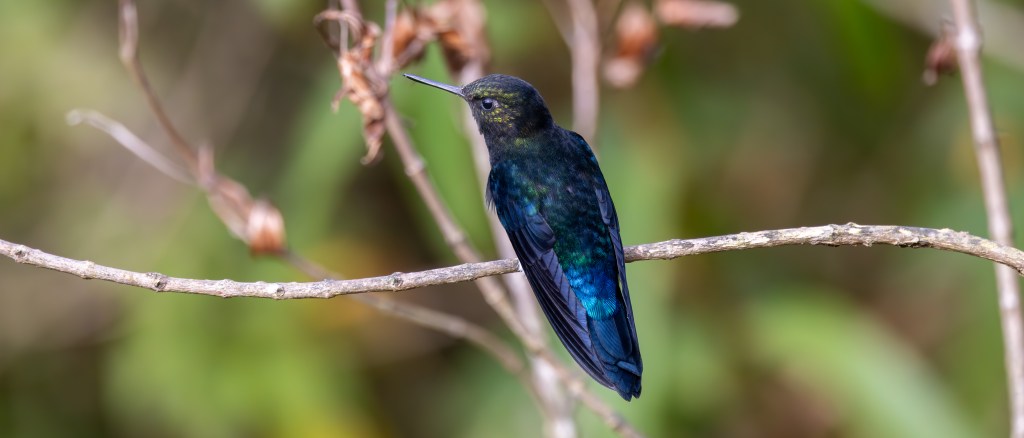
We had been jumping from one feeder to the next at Zuro Loma when the caretaker hurried over and commented that the Black‑breasted Puffleg had just been seen down the trail. My heart jumped. We followed him quickly down a narrow path toward a cluster of flowering bushes. I expected the bird to be at the feeders ahead, but he stopped abruptly and said, “Look very slowly over your right shoulder. It’s perched about two meters away.” I turned carefully—and there it was.

The critically endangered BLACK-BREASTED PUFFLEG, glowing in perfect sunlight, perched so close I could hardly believe it. I stepped aside to get a better angle and fired off several shots before it lifted and disappeared into the trees. I stood there stunned, realizing how extraordinarily lucky I had been to see it at all, let alone at such close range. It is claimed to be in the top 50 rarist birds to see on the entire planet!
It is claimed to be in the top 50 rarist birds to see on the entire planet!

The Black‑breasted Puffleg, one of Ecuador’s most elusive hummingbirds, survives today on the knife‑edge of extinction. Its entire global range is restricted to a tiny band of humid elfin forest on the northwestern slopes of Volcán Pichincha—habitat that has been steadily chipped away by agriculture, cattle grazing, road building, and the expansion of communication towers along the ridgelines. Much of the remaining forest is fragmented into isolated patches, making it difficult for this high‑elevation specialist to move, feed, or find mates.

Climate change adds yet another pressure, pushing suitable habitat higher up the mountain where less and less forest remains. With such a narrow ecological niche and so few safe refuges left, the Black‑breasted Puffleg has become one of the most critically endangered hummingbirds on Earth, a species whose survival now depends on the protection and restoration of the last remnants of its cloud‑shrouded home.

Searching for the Black‑breasted Puffleg at Zuro Loma carried a kind of emotional gravity that is hard to put into words. Every step along the moss‑draped trail felt charged with possibility, as if the very air held its breath. Knowing that only a handful of these hummingbirds survive in the wild made the forest feel sacred—each patch of elfin vegetation a potential sanctuary for a creature on the brink. The silence between the calls of tanagers and brushfinches seemed deeper, more deliberate, as though the mountain itself understood the rarity of what we sought. With every distant wing‑whirr or flash of iridescence, my heart leapt, torn between hope and the quiet acceptance that some species are now so scarce that even a glimpse is a privilege.

The search became more than a quest for a lifer; it felt like a pilgrimage, a moment to honor a bird whose existence hangs by a thread and whose survival depends on the fragile persistence of this cloud‑shrouded world.
NEXT UP: EB#9 “A Missed Antpitta, More Sword-billeds and a Scarlet-bellied Success“
Additional Photographs


Previous Ecuador Birding Blog Posts:
- EB40 – Early Morning Wings at the Moth Light Feeders of Cabañas San Isidro
 In October 2025, Jim Gain joined a birding tour in Ecuador, exploring its rich biodiversity and stunning landscapes over 14 days. The blog series chronicles his experiences with birds and nature.
 - EB39 – Wildlife and Mountain Mists on the Road to San Isidro
 In October 2025, Jim Gain joined a birding tour in Ecuador, exploring its rich biodiversity and stunning landscapes over 14 days. The blog series chronicles his experiences with birds and nature.
 - EB38 – Sunlit Surprise: The Golden‑Tailed Sapphire’s Rainbow Glow
 In October 2025, Jim Gain joined a birding tour in Ecuador, exploring its rich biodiversity and stunning landscapes over 14 days. The blog series chronicles his experiences with birds and nature.
 - EB37 – The Numbers Keep Climbing: WildSumaco’s Hummingbird Explosion Continues
 In October 2025, Jim Gain joined a birding tour in Ecuador, exploring its rich biodiversity and stunning landscapes over 14 days. The blog series chronicles his experiences with birds and nature.
 - EB36 – From Farmland to Sanctuary: WildSumaco’s Rebirth and Its Earliest Arrivals
 In October 2025, Jim Gain joined a birding tour in Ecuador, exploring its rich biodiversity and stunning landscapes over 14 days. The blog series chronicles his experiences with birds and nature.
 - EB35 – Leaving the Amazon Behind, Rising into the Eastern Andes
 In October 2025, Jim Gain joined a birding tour in Ecuador, exploring its rich biodiversity and stunning landscapes over 14 days. The blog series chronicles his experiences with birds and nature.
>>Ecuador Birding Blog Home Page Link https://reflectionsofthenaturalworld.com/ecuador-birding/
*This Ecuador Birding blog post was shaped and polished with the assistance of Microsoft Copilot, helping bring clarity and a consistent flow to my field notes and dictated memories.

 Reflections of the Natural World
Leave a comment