
One Moment in Nature is a reflection back in time to a moment of discovery as I explored the natural settings around me. Through the sharing of this moment, is my hope that readers will become motivated to learn more about our environment and its inhabitants, and become passionate advocates for conservation. One Moment in Nature is a Reflections of the Natural World Blog Post Series by Jim Gain
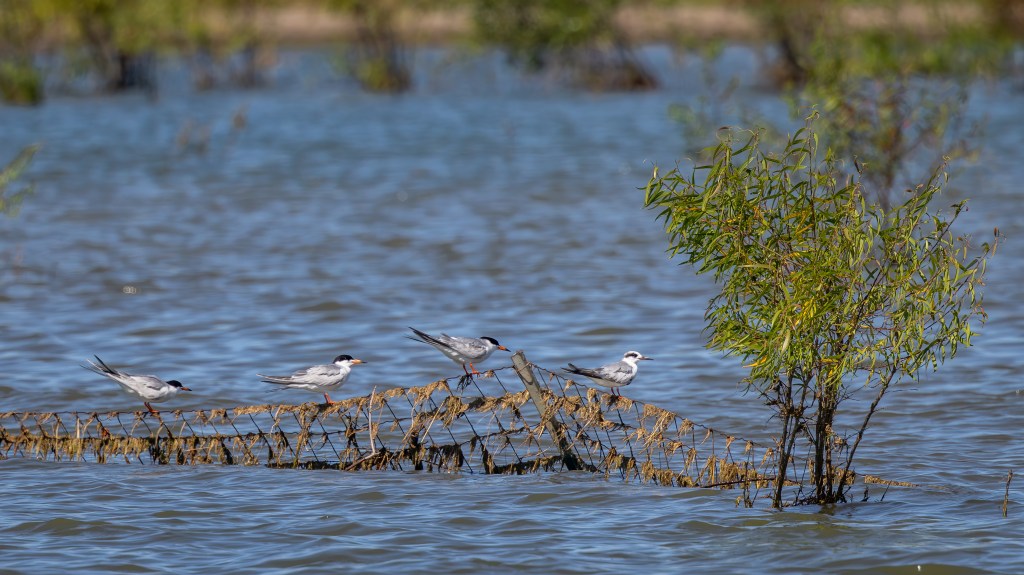
THE FORSTER’S TERN MOMENT – Excluding a handful of rare winter occurences, the Forster’s Tern (Sterna forsteri), is California’s most common summer visiting and breeding tern. On this morning I was hoping to document another year’s successful breeding colony on one of the islands in the middle of Turlock Lake. As I slowly cruised down the Fishing Access road I could see several Forster’s Terns out diving for fish in the middle of the lake. Several birds flew by in close with several landing to perch on the partially submerged fenceline. While I was unable to visually confirm active nests on the island due to lack of access, I did encounter approximately 35 terns in the immediate area, many of which were this year’s juvenals. Over the course of the next couple of days I found additional nesting success at both Modesto Reservoir (25 birds) and Woodward Reservoir (10 birds).

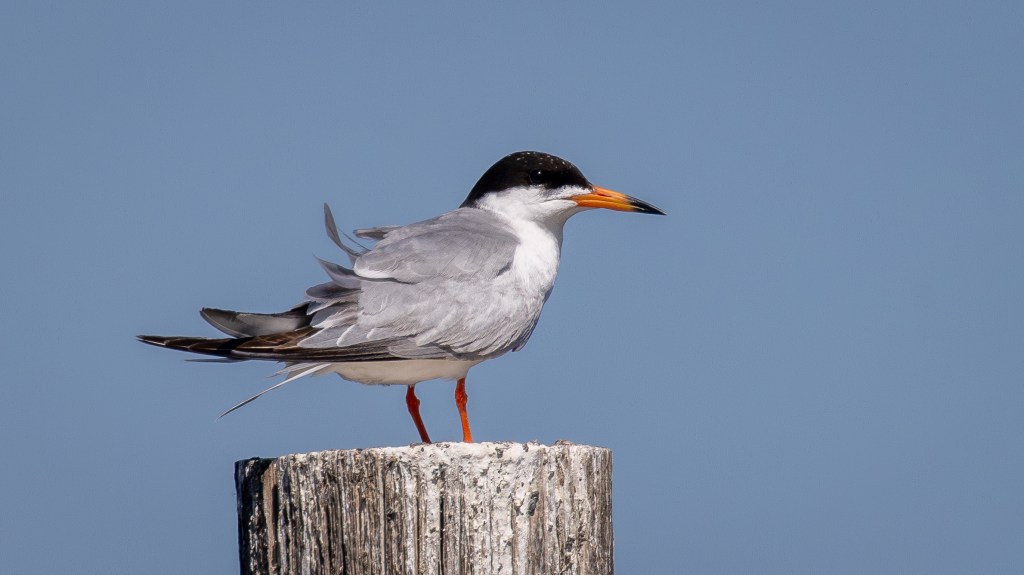
PHYSICAL DESCRIPTION – Forster’s Tern is a sleek, medium-sized tern with a sharp orange bill tipped in black, pale gray upperparts, and a deeply forked tail that flashes white in flight. In breeding plumage, it sports a black cap and bright white underparts, while in winter, the cap recedes to a dark eye patch on a white head.

WHAT’S IN A NAME – Latin sterna = tern; forsteri after Johann Reinhold Forster (1729-1798) German naturalist who accompanied Captain James Cook on his three-year voyage of discovery 1772-1775.

DISTRIBUTION AND STATUS IN CALIFORNIA’S CENTRAL VALLEY – Forster’s Tern occurs locally in California’s Central Valley, primarily during the breeding season in managed wetlands, sloughs, and flooded agricultural fields, especially in the Sacramento–San Joaquin Delta and adjacent refuges. It is generally uncommon but regionally important, nesting in colonies on floating vegetation or levee edges and foraging over open water for small fish and aquatic invertebrates. The species is listed as Least Concern by the IUCN, with a stable population overall, though wetland loss and water management practices pose ongoing challenges to its breeding success in the valley. Natural history observations highlight its graceful flight, sharp calls, and seasonal shifts in plumage, with courtship and nesting peaking in late spring and early summer.

Most recent Blog Posts from the One Moment in Nature series.

 Reflections of the Natural World
Leave a comment