


BLACK SKIMMER – Blog Post Series #64
Central Valley Birds and Birding: – Over 300 wild bird species either live in or pass through California’s Central Vally on a regular basis. The intent of this blog is to ignite a spark of curiosity in our followers that motivates them to learn more about these wild inhabitants and the environs they frequent. A Reflections of the Natural World Blog Post Series hosted by Jim Gain
TAXONOMIC TREE: Charadriiformes, Laridae, Rynchops niger
CENTRAL VALLEY BIRDS & BIRDING: Black Skimmer
The Black Skimmer, one of North America’s most distinctive coastal waterbirds, is noted for its unusual voice, bill, and feeding behavior. Its bill—brightly colored, laterally compressed, and knife-like, with the lower mandible extending beyond the maxilla—is uniquely adapted to catch small fish in shallow water. A feeding skimmer flies low over the water with its bill open and its lower mandible slicing the surface. When the mandible touches a fish, the upper bill (maxilla) snaps down instantly to catch it. (from Birds of the World)
WHAT’S IN A NAME
BlackSkimmer – Rynchops nigra
Rynchops Greek. ῥυγχος rhunkhos bill; L. niger black, dark coloured, shining black, jet black

DISTRIBUTION


HISTORY OF BLACK SKIMMER OBSERVATIONS IN THE CENTRAL VALLEY
- 1986 KERN Co (2 adults, 3 juvs) – eBird Checklist 1986-07-19 Cliff Peterson and Mark Chichester at the Evaporation Ponds (KER Co.)
- 2013 KERN Co (1 adult) – eBird Checklist 2013-07-22 first seen by Mark Stacy, also seen by 9 others (JoL, DaF, StSu, FOl, JiL, JoLo, LiPi
- 2017 YOLO Co (1 adult) – eBird Checklist 2017-07-04 first reported by Ed Harper and Hugh Dingle, also seen by 16 others
- 2020 KERN Co – eBird Checklist 2020-07-18 first reported by Mark Stacy, also seen by Steve Summers, Susan Steele, Bob Steele and John Luther
- 2021 KERN Co (2 adults) eBird Checklist 2012-08-02 by Logan Kahle
- 2022 CONTRA COSTA Co (1 adult) – eBird Checklist 2022-07-05 first reported by Jerald Britten and Srikant Char
- 2024 STANISLAUS Co (2 adults) – eBird Checklist 2024-06-08 first reported by Jim Gain
OBSERVATION ANECDOTES
I had signed up to bird the Modesto Secondary Wastewater Treatment Plant (Restricted Access) on Saturday, June 8th in the hopes that I might find a BROWN PELICAN, that would be a new county bird for me. Other Brown Pelicans had been reported in San Joaquin County and I needed one to add to my total species seen in Stanislaus County. I stood at 299 species seen and I was clearly hoping for #300! I had carefully toured most of the facilty without luck when I thought I saw a flock of Marbled Godwits on a mudflat. I quickly stopped and got out my scope so that I could verify what species they were and how many. Marbled Godwits are a rare, but regular migrant and I wanted to be certain and to then photograph them for the record. As I scanned the shoreline expecting to see chunky long-legged and long-billed shorebirds, I was not prepared for what was sitting there as calmly and serenly as could be. Stretching and pointing their bills to the sky, bills that were bright red and black, bodies with pure white faces and bellies, and black as coal backs and wings, a pair of BLACK SKIMMERS! One was clearly larger by about 25% over the other. I immediately grabbed my camera and started shooting. Something spooked all of the birds and I picked up on the pair as they circled away, but then turned back towards me flying in front of me to land close to where they were before. Stanislaus County species #300 was in the bag!
Oh, I never did refind the godwits…
PHOTO GALLERY (FROM THE MODESTO WATER TREATMENT FACILITY)


PHOTO GALLERY (FROM SOUTH PADRE ISLAND, TX)


3 Most Recent Learn 100 Common Valley Birds Posts
- Northern Pintail
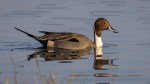 LEARN 100 COMMON VALLEY BIRDS The Northern Pintail is a Fairly Common Winter Visitor in California’s Central Valley and can be found in Freshwater Wetlands and Open Water.
 - Say’s Phoebe
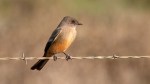 LEARN 100 COMMON VALLEY BIRDS The Say;s Phoebe is a Fairly Common Yearround Resident in California’s Central Valley and can be found in Grasslands and Freshwater Wetlands.
 - Cinnamon Teal
 LEARN 100 COMMON VALLEY BIRDS The Cinnamon Teal is a Fairly Common Yearround Resident in California’s Central Valley and can be found in Freshwater Wetlands and Open Water.

 Reflections of the Natural World
Leave a comment