Western Europe Birds & Birding (#38/52): From the Highland Willow Scrub of Scotland to the Aegean Islands in the Sea of Crete, Western Europe is home to over 800 resident, migratory and vagrant birds. From songbirds to gamebirds and from waterfowl to raptors, you can find birds virtually in every nook and cranny of this beautiful area. *All images showcased in this blog series were taken and edited by me.
A Reflections of the Natural World Blog Post Series by Jim Gain
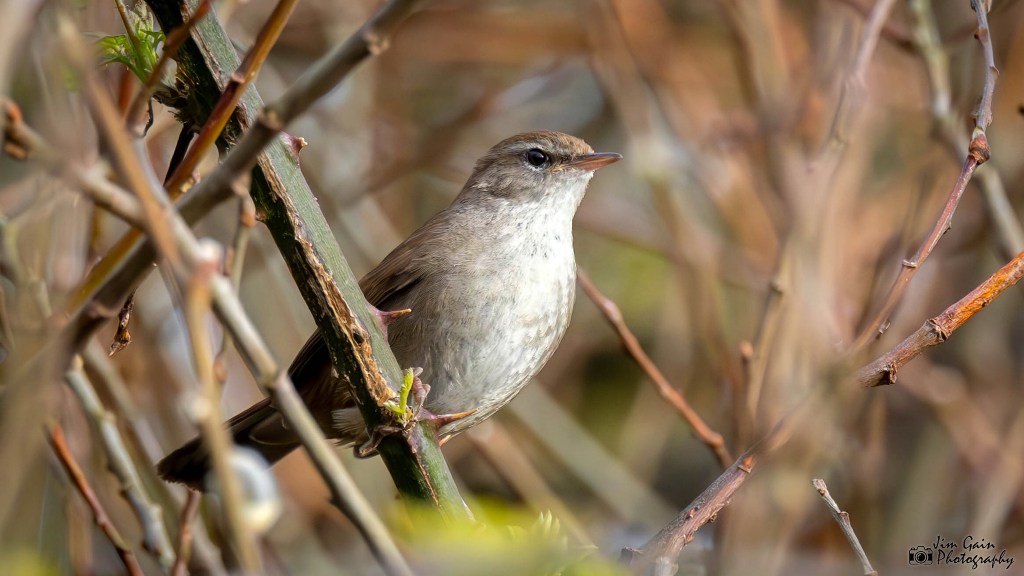
Cetti’s Warbler (Cettia cetti), with its skulking behavior and distinctive features, Is a captivating bird species in the avian world.

Physical Characteristics:
The Cetti’s Warbler (Cettia cetti) is a small, brown bush-warbler that inhabits various regions. It measures approximately 13–14 cm (5.1–5.5 inches) from bill to tail. The male weighs 15 g (0.53 oz), while the female is slightly lighter at 12 g (0.42 oz). Key features include:
- Head: Rounded head with a narrow pale grey stripe arching over conspicuous black eyes.
- Wings: Short, rounded wings.
- Upperparts: Rich chestnut or dark reddish-brown.
- Throat and Breast: Pale grey.
- Tail: Longer and broader than many other warblers.
- Plumage: Both sexes have similar plumage, but males are 26% to 32% heavier than females, with longer wings. Juveniles resemble adults but have fresh plumage and two dark or dark grey spots on the tongue. Interestingly, Cetti’s warbler has ten tail feathers (rectrices), which is unusual among passerine birds.

Diet:
Cetti’s warblers are insectivorous. They primarily prey on small, soft-bodied insects and larvae. Their preference for tiny insects allows them to digest their food more efficiently.

Abundance and Distribution:
- Geography: Cetti’s warblers breed in southern and central Europe, northwest Africa, and the east Palearctic, extending as far as Afghanistan and northwest Pakistan.
- Habitat: They inhabit damp areas, including ponds, lakes, marshes, and rivers. Their preferred habitats are reedbeds and dense, scrubby vegetation near water.
- Distribution: These elusive birds can be found in countries such as China, Spain, Portugal, France, the United Kingdom, Albania, Belgium, Bosnia and Herzegovina, and Bulgaria.
- British Breeding: Uniquely among British-breeding birds, Cetti’s warblers have only ten tail feathers instead of the usual twelve.

IUCN Red List Status:
Cetti’s warbler is currently classified as “Least Concern” (LC) on the IUCN Red List. This status indicates that their population is relatively stable and not facing immediate threats to survival. However, conservation efforts are essential to maintain their habitats and protect their populations.
For more information, you can explore the IUCN Red List and learn about the conservation status of various species.
CETTI’S WARBLER WAS LIFER #820

 Reflections of the Natural World
Leave a comment