Western Europe Birds & Birding (#23/52): From the Highland Willow Scrub of Scotland to the Aegean Islands in the Sea of Crete, Western Europe is home to over 800 resident, migratory and vagrant birds. From songbirds to gamebirds and from waterfowl to raptors, you can find birds virtually in every nook and cranny of this beautiful area. *All images showcased in this blog series were taken and edited by me.
A Reflections of the Natural World Blog Post Series by Jim Gain
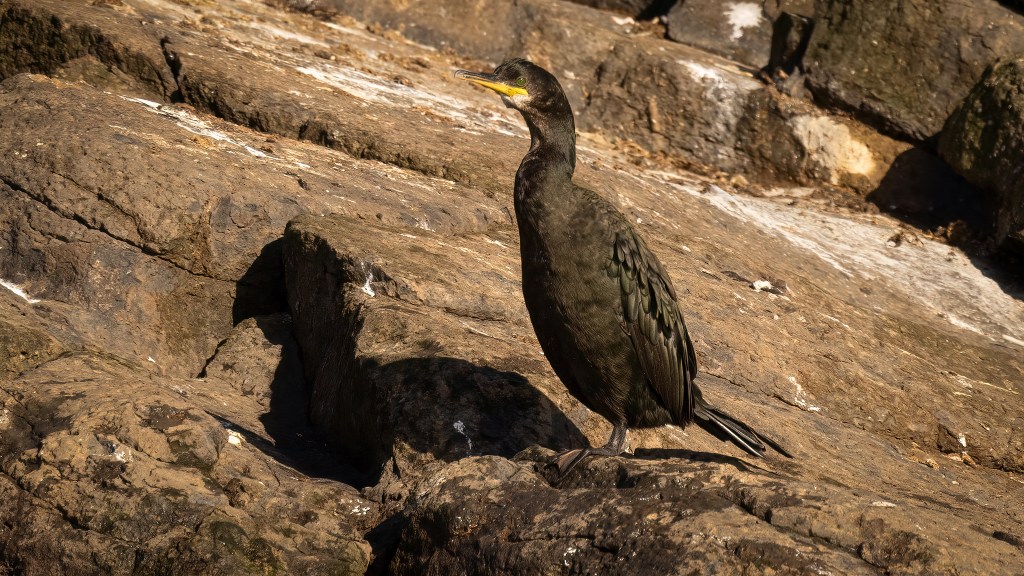
The European Shag is an impressive seabird with a penchant for diving, a striking appearance, and a widespread distribution along Europe’s coastlines.

Physical Characteristics:
- Skills: The European Shag is an adept fisher:
- Size: It measures around 70 to 90 centimeters in length.
- Coloration: Its plumage is predominantly dark glossy green-black. During the breeding season, adults exhibit a prominent crest on their heads.
- Bill: The bill is long and pointed, ideal for capturing fish underwater.
- Legs and Feet: These are black and adapted for perching on rocky cliffs.

Diet:
- Primary Diet: It primarily feeds on fish, especially species like sand eels, herring, and sprats.
- Foraging Technique: It dives into the water from cliffs or rocky ledges, pursuing its prey beneath the waves.
- Underwater Hunting: With its streamlined body, it can swim and hunt underwater with agility.

Abundance and Distribution:
Breeding Range: European Shags breed along the coastlines of northern Europe, including regions such as the British Isles, Scandinavia, and the Baltic Sea.
Wintering Areas: During winter, they disperse more widely, reaching southern Europe and even venturing into the Mediterranean.
Habitat: They prefer rocky coastal cliffs, where they build their nests in crevices or on ledges.

Population Trends: The population size varies across different countries.
- In France, there are approximately 7,300 to 7,500 breeding pairs.
- In Norway, the population stands at around 28,000 pairs.
- Iceland hosts 3,700 to 3,800 breeding pairs.
- Russia has 900 to 1,100 pairs of the subspecies G. a. aristotelis.
- Spain harbors 2,000 to 2,100 pairs.
- Italy reports 1,500 to 2,100 pairs.
- Portugal has a smaller population of 100 to 150 pairs.
- Other countries also contribute to the overall European Shag population.
IUCN Red List Status:
The European Shag’s conservation status is assessed by the IUCN Red List. As of now, it falls into the category of Least Concern. However, it’s essential to monitor its populations due to potential threats such as habitat degradation, pollution, and disturbance.
For more information, you can explore the IUCN Red List and learn about the conservation status of various species.

EUROPEAN SHAG WAS LIFER #818
European Shag 08 Oct 2022 Bass Rock Boat Trip | GB-SCT
- Grandchildren and Oystercatchers at Weybourne Beach, Norfolk, England
- A Noisy Encounter with a Short-toed Treecreeper at Etang de L’Ursine, France
- Reed Bunting
- European Goldfinch
- European Greenfinch
BANDED BIRDS: Two of the Shags were banded and I got this response from Mark Newell at the UK Centre for Ecology & Hydrology.


 Reflections of the Natural World
Leave a comment