Western Europe Birds & Birding (#1/52): From the Highland Willow Scrub of Scotland to the Aegean Islands in the Sea of Crete, Western Europe is home to over 800 resident, migratory and vagrant birds. From songbirds to gamebirds and from waterfowl to raptors, you can find birds virtually in every nook and cranny of this beautiful area. *All images showcased in this blog series were taken and edited by me.
A Reflections of the Natural World Blog Post Series by Jim Gain
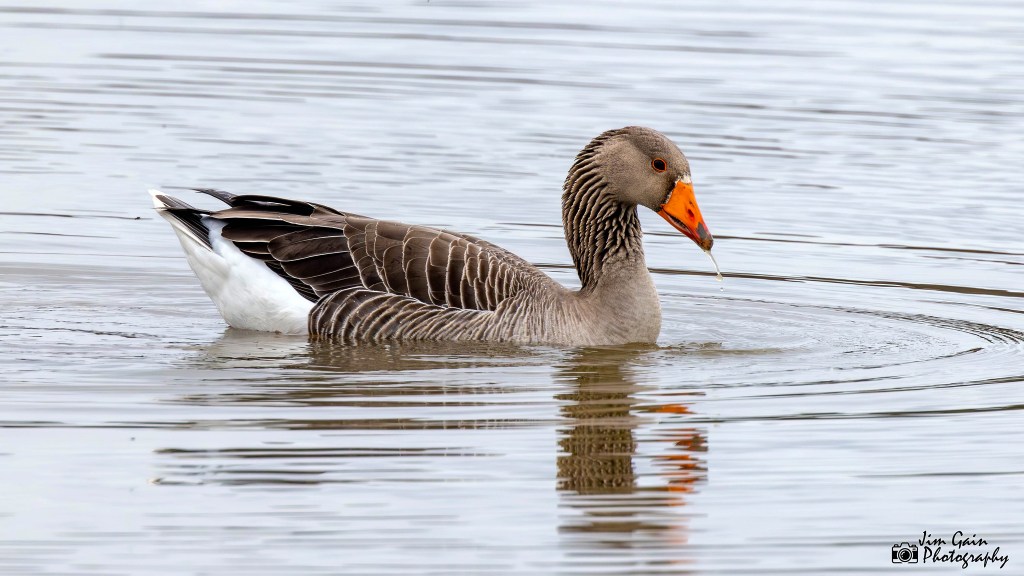
The Greylag goose (Anser anser) is a large waterfowl species belonging to the family Anatidae.

Physical Characteristics:
The Greylag Goose is the largest and most robust of the grey geese within the genus Anser. Its physique features a rotund, bulky body, a long and thick neck, and a large head with an orange or pink bill. The plumage is predominantly greyish-brown, with a darker head and paler breast and belly, often adorned with black spotting. When in flight, the pale grey forewing and rump become noticeable, as do the light-colored wing coverts contrasting with the darker flight feathers. Adults exhibit a distinctive ‘concertina’ pattern of folds in their neck feathers. Juveniles lack the black speckling on the breast and belly and have greyish legs.

Diet:
The Greylag goose is primarily herbivorous, with a varied diet:
- Graminivore: It grazes on grasses.
- Folivore: It consumes leaves.
- Granivore: It feeds on grains.
- Semiaquatic: It forages in water.

Abundance and Distribution:
The Greylag goose has a widespread distribution: Birds from the northern parts of Europe and Asia migrate southwards during winter to warmer regions. Breeding occurs in Iceland, Norway, Sweden, Finland, the Baltic States, northern Russia, Poland, Hungary, Romania, and other European countries. The eastern race extends across Asia to China. Locally, they breed in the United Kingdom, Denmark, Germany, Austria, the Czech Republic, Slovakia, and North Macedonia.

IUCN Red List Status:
The Greylag goose is classified as Least Concern on the IUCN Red List. This status is based on its extremely large range and population size, which appears to be increasing.
For more information, you can explore the IUCN Red List and learn about the conservation status of various species.

GRAYLAG GOOSE WAS LIFER # 778


 Reflections of the Natural World
Leave a comment