

Learn 100 Common Valley Birds Blog Post #36 (Species 57/100)
Few things on earth fill us with as much delight as birds, and knowing them by name only adds to our pleasure. In California’s Central Valley, with only a little bit of effort, anyone can learn 100 local bird species. Especially since on a daily basis Valley Residents come in contact with at least a dozen species that most recognize, but may not know the name of. The intent of this blog is for followers to learn about and be able to identify 100 common valley birds.
A Reflections of the Natural World Blog Post Series by Jim Gain

WHAT’S IN A NAME?
Western Grebe – Aechmophorus occidentalis
Name Roots: (Gr. aichme, “spear”; phoreus, “bearer” – L. occidentalis, “western”)
PHYSICAL CHARACTERISTICS
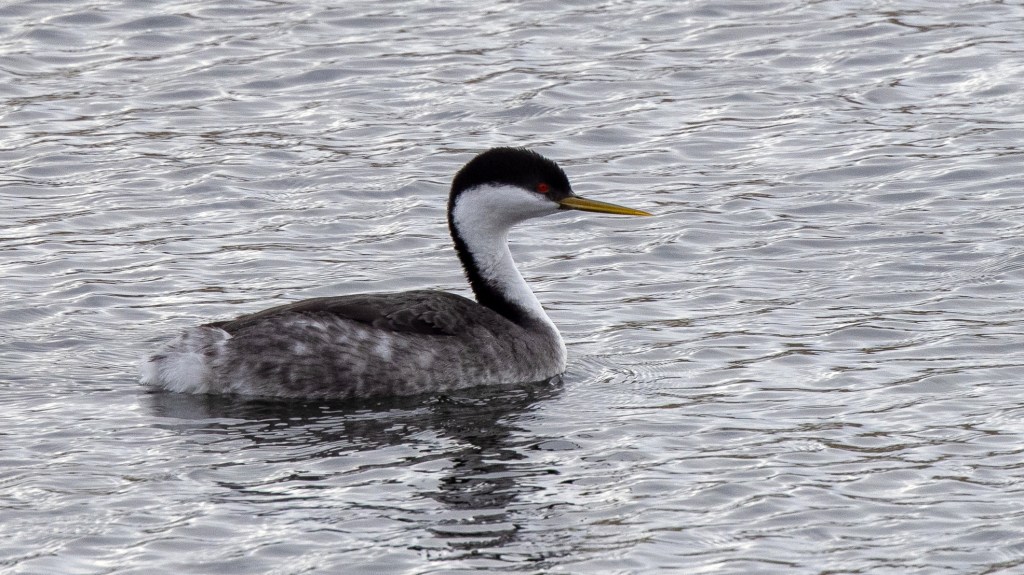
The Western Grebe is the largest among North American grebes. It has a slender body with crisp black-and-white plumage, a yellow bill, and a red eye. It differs slightly from the Clark’s Grebe in that the black cap does reach the eye and bill. Its eye is completely surrounded by black feathering. Its long neck is nearly twice the length of its body and is composed of 17–21 vertebrae. The feet of the Western Grebe are flattened, which lessens resistance and aids in propulsion during swimming and diving.

An interesting fact about the Western Grebe is that it is renowned for its ballet-like courtship display in which the male and female “run” across the water in synchrony¹. This dance is known to be one of the most elaborate among water bird species.
DISTRIBUTION STATUS IN THE CENTRAL VALLEY
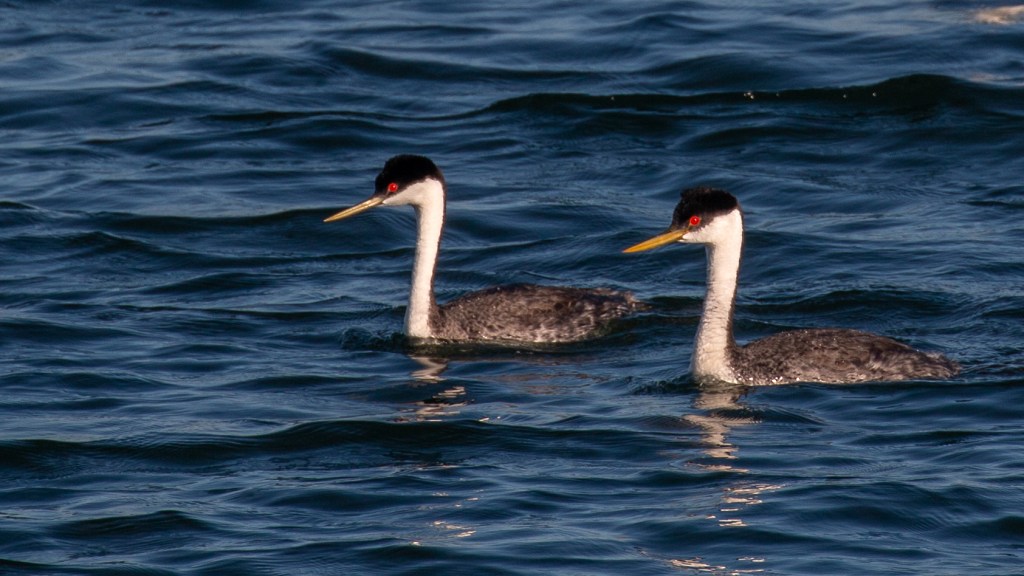
The Western Grebe is a Fairly Common Yearround Resident in the Central Valley and can be found in almost any area with open water.


 Reflections of the Natural World
Leave a comment