
Saskatchewan Birds – Oiseaux in the Land of Living Skies – Post #3
Saskatchewan’s slogan, “The Land of Living Skies” could refer as much to its magnificent birdlife as it does to its awe-inspiring Northern Lights and spectacular thunderstorms experienced there. This centrally located Canadian Province’s “Land of Living Skies” is home to over 400 recorded oiseaux (Fr. bird) species. Using my personal photographs in a blog post format, viewers will learn about the natural history and conservation status of these interesting birds in the Land of Living Skies!
A Reflections of the Natural World Blog Post Series by Jim Gain
WHAT’S IN A NAME
Canada Warbler – Cardellina canadensis
Name Roots: (Italian dialect name Cardella for a Goldfinch < L. cardella or cardellus – of Canada)

PHYSICAL CHARACTERISTICS
The Canada Warbler is a small, colorful songbird. Males are more brightly marked than females and immatures, with blue-grey upperparts and tail contrasting with a yellow throat and breast. Black stripes form a necklace on the breast, which is bolder on males than on females. It has two small black eyes each surrounded by a white circle. It is 4.7 to 5.9 inches long and it’s three to four inches tall. This is a tiny bird weighing from 0.32 to 0.46 ounces. The wingspan of the Canada warbler is seven to nine inches.

DISTRIBUTION & OCCURRENCE IN THE LAND OF LIVING SKIES
The Canada Warbler is a localized, uncommon breeder to fairly common spring and fall migrant of the Boreal Forests of Central Saskatchewan. It is a small boreal songbird of the New World warbler family (Parulidae) that summers in Canada and northeastern United States and winters in northern South America.
eBird Bar Charts for Saskatchewan


CONSERVATION STATUS – International Union for Conservation of Nature (IUCN) Red List Category
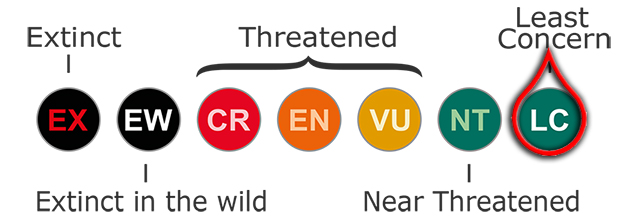
The Canada Warbler (CAWA) is classified as Least Concern by the IUCN.
Redlist Classification Justification: This species has an extremely large range, the population trend appears to be *slightly decreasing, and the population size is extremely large. For these reasons the species is evaluated as Least Concern.
*Despite the fact that the population trend appears to be decreasing, the decline is not believed to be sufficiently rapid to approach the thresholds for Vulnerable under the population trend criterion (>30% decline over ten years or three generations).


 Reflections of the Natural World
Leave a comment